

Strategic Context
Rural TEA EB-5 projects have become a central focus for investors following the EB-5 Reform and Integrity Act of 2022, which introduced reserved visa set-asides and reinforced incentives for capital deployment into underserved regions.
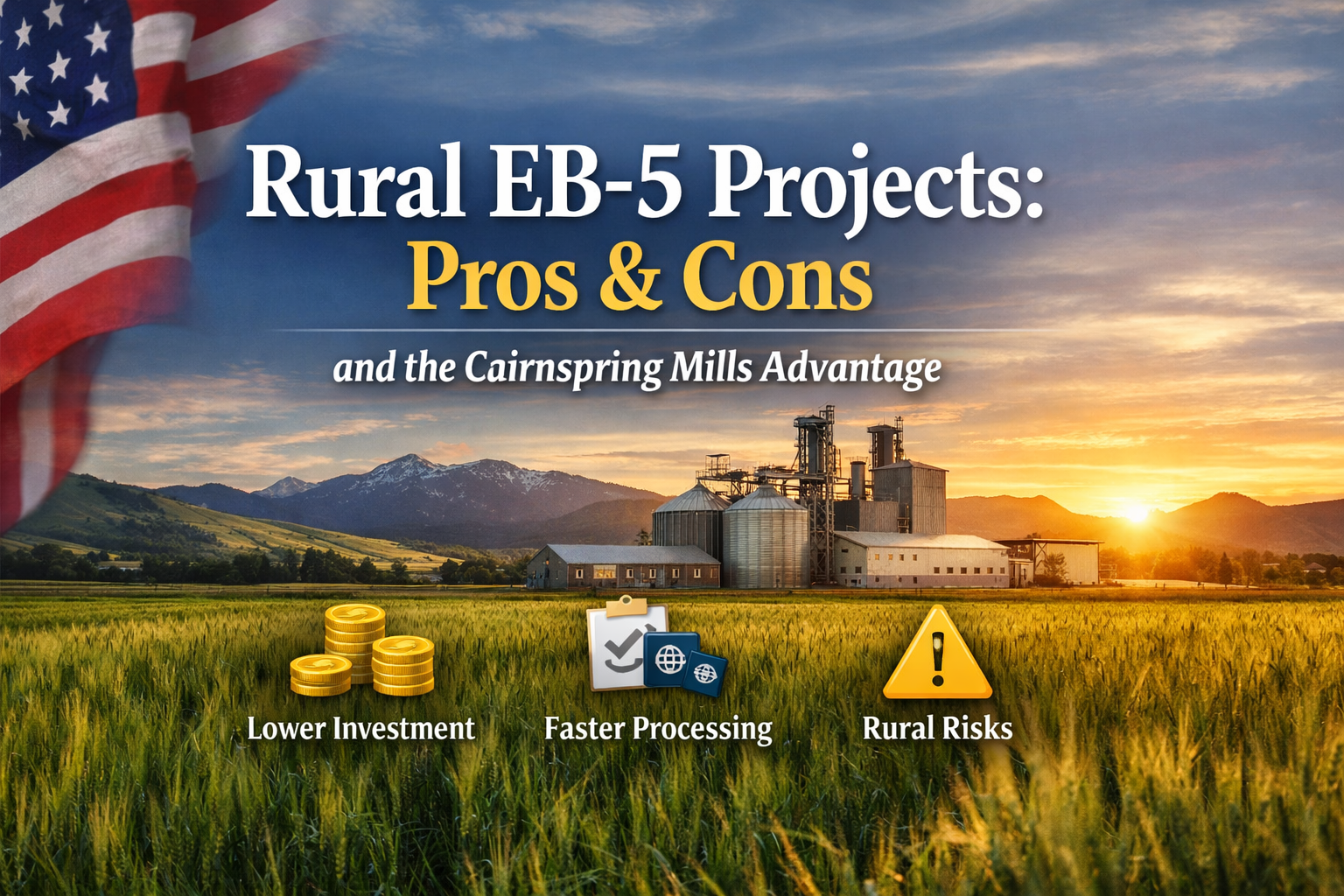
The appeal is clear:
• Lower investment threshold ($800,000)
• Reserved visa allocation (reduced backlog exposure)
• Potentially faster processing timelines
However, while these structural advantages are real, rural projects are not always great investments.
It’s important to understand what makes certain rural projects true winners, and to remain focused on those core investment principles.
The Structural Advantages of Rural EB-5
From an immigration standpoint, rural projects are currently positioned favorably.
1. Capital Efficiency
The $800,000 TEA threshold represents a meaningful reduction in required capital relative to standard EB-5 investments.
2. Visa Availability
Rural projects benefit from a 20% annual visa set-aside, which has remained current (no backlog) across all nationalities in recent Visa Bulletins. This means investors from high-demand nations, such as India and China, have been able to file their Green Card applications simultaneously with their investment petition (concurrent filing) to bypass the long waiting lines (retrogression) that exist for the “unreserved” EB-5 categories.
3. Processing Dynamics
Dedicated adjudication pathways have resulted in materially faster processing in many cases, particularly relative to legacy EB-5 queues. USCIS queue yields approvals in 5-9 months (2025 average), vs. 1+ years for non-rural (20% visa set-aside avoids backlogs).
4. Policy Alignment
Rural EB-5 aligns directly with Congressional intent: channeling foreign capital into underinvested regions, supporting job creation and local economic development.
Due to these advantages, we’ve seen higher USCIS adjudication for rural cases (65% of all cases), higher I-526E approval ratings (94-96%), and faster processing times (4x-5x faster than urban projects).
The Underlying Risks: Where Investors Should Be Disciplined
Despite these advantages, rural EB-5 introduces a different set of risks—often underappreciated.
1. Economic Concentration Risk
Rural markets typically rely on fewer industries, making them more sensitive to sector-specific downturns.
2. Cyclicality and Volatility
Particularly in real estate-driven projects, rural regions can experience sharper boom-bust cycles due to limited demand depth.
3. Market Familiarity Risk
Investor hesitation is not purely financial. Many investors are less comfortable allocating capital into unfamiliar rural geographies, which can impact subscription velocity.
4. Limited Project Universe
Strict rural TEA criteria (outside metropolitan statistical areas, low population density of less than 20,000 inhabitants) inherently reduce the number of viable, high-quality projects.
As a result, rural EB-5 should not be evaluated as “safer” or “riskier” in isolation—it should be evaluated based on project fundamentals.
What Defines a Strong Rural EB-5 Project
The most compelling rural projects share a consistent profile:
They are not dependent on local speculation.
They are driven by operating businesses with real demand.
Key indicators include:
• Business-driven model vs. real estate dependency
• Strong profitability metrics (15%+ EBITDA), which supports ample debt service coverage (DSCR) or refinance opportunities
• Multiple layers of downside protection (cash flow + collateral)
• Execution certainty (fully financed, active construction)
• Transparent job creation and reporting
In short: institutional discipline over geographic designation.
Case Study: Cairnspring Mills
Cairnspring Mills illustrates how a rural EB-5 project can mitigate many of the traditional risks associated with rural investments.
1. Not Dependent on Local Rural Demand
While located in a rural area, the business is tied to the U.S. food supply chain, with national distribution and diversified revenue channels.
2. Industry Resilience
Food production—particularly staple categories like flour—has historically demonstrated consistent demand across economic cycles, reducing volatility relative to discretionary sectors.
3. Operating Track Record
A 10+ year profitable business, not a speculative development.
4. Strong Capital Structure
• 50% equity cushion beneath EB-5 capital
• Operating cash flow support (17% EBITDA margin)
• Hard collateral (mill + parent company assets)
5. Active Execution
• Construction underway
• Job creation already in progress
• Ongoing reporting and transparency
6. Institutional Validation
Strategic relationships and blue chip investor backing provide additional third-party validation of the business model.
Importantly, the investment thesis is not dependent on rural real estate appreciation.
It is driven by production, distribution, and revenue generation.
Reframing Rural EB-5: From Location to Structure
The key takeaway is simple:
Rural EB-5 is not inherently superior.
Nor is it inherently riskier.
It is structurally advantageous from a visa perspective,
but performance depends entirely on project selection.
The strongest rural projects are those that:
• Operate within resilient industries
• Generate revenue beyond local markets
• Maintain disciplined capital structures
• Provide clear visibility into execution
Final Strategic Conclusion
For investors evaluating EB-5 as part of a broader capital and residency strategy:
• The benefits of rural EB-5 are real
• The risks are equally real—but manageable
• The differentiator is project quality, not designation
Rural EB-5 should not be approached as a shortcut.
It should be approached as a selective allocation strategy within a constrained system.
For investors assessing global diversification and U.S. residency positioning, the objective is clear:
Not simply to choose “rural”—
but to identify rural projects with institutional-grade fundamentals and resilient economic drivers.
For more information on our Cairnspring Mills Rural Project, click here:
To schedule to speak with our team at EB-5 Visa Investors, contact us here
Citations:
A rural EB-5 project is an investment located outside a metropolitan statistical area (MSA) and in a region with a population of fewer than 20,000 people. Under current EB-5 regulations, these projects benefit from reserved visa set-asides and are often eligible for faster processing timelines.
Rural EB-5 projects benefit from a dedicated visa allocation (20% of annual EB-5 visas) and priority adjudication under current policy. Because demand in this category remains lower than supply, many investors experience reduced backlog risk and more efficient processing compared to non-rural projects.
Not inherently—but they present different risks. Rural projects may face greater exposure to local economic volatility, smaller customer bases, and limited infrastructure. However, well-structured rural projects with strong operating businesses, diversified revenue, and institutional-level underwriting can effectively mitigate these risks.
Investors should prioritize projects with operating business fundamentals rather than speculative real estate exposure. Key indicators include strong cash flow, healthy debt service coverage, multiple layers of collateral, transparent job creation reporting, and construction or operational progress already underway.
Cairnspring Mills mitigates common rural risks by operating within the U.S. food supply chain, with national distribution and consistent demand. Its revenue model is not dependent on local rural market conditions, and its capital structure includes significant equity, operating cash flow support, and hard collateral—providing a more resilient investment profile.
