.png?width=1906&height=652&name=Logo%20Pill%20Blue%20(2026_03_27%2017_45_45%20UTC).png)

EB-5 EAD
.png?width=48&height=48&name=eb5%20visa%20investors%20favicon%20(2026_03_28%2019_48_32%20UTC).png)
Several important EB-5 dates are approaching, but they do not all have the same meaning. In particular, there has been some confusion about whether the EB-5 Regional Center Program will end on September 30, 2026.
The short answer is no.
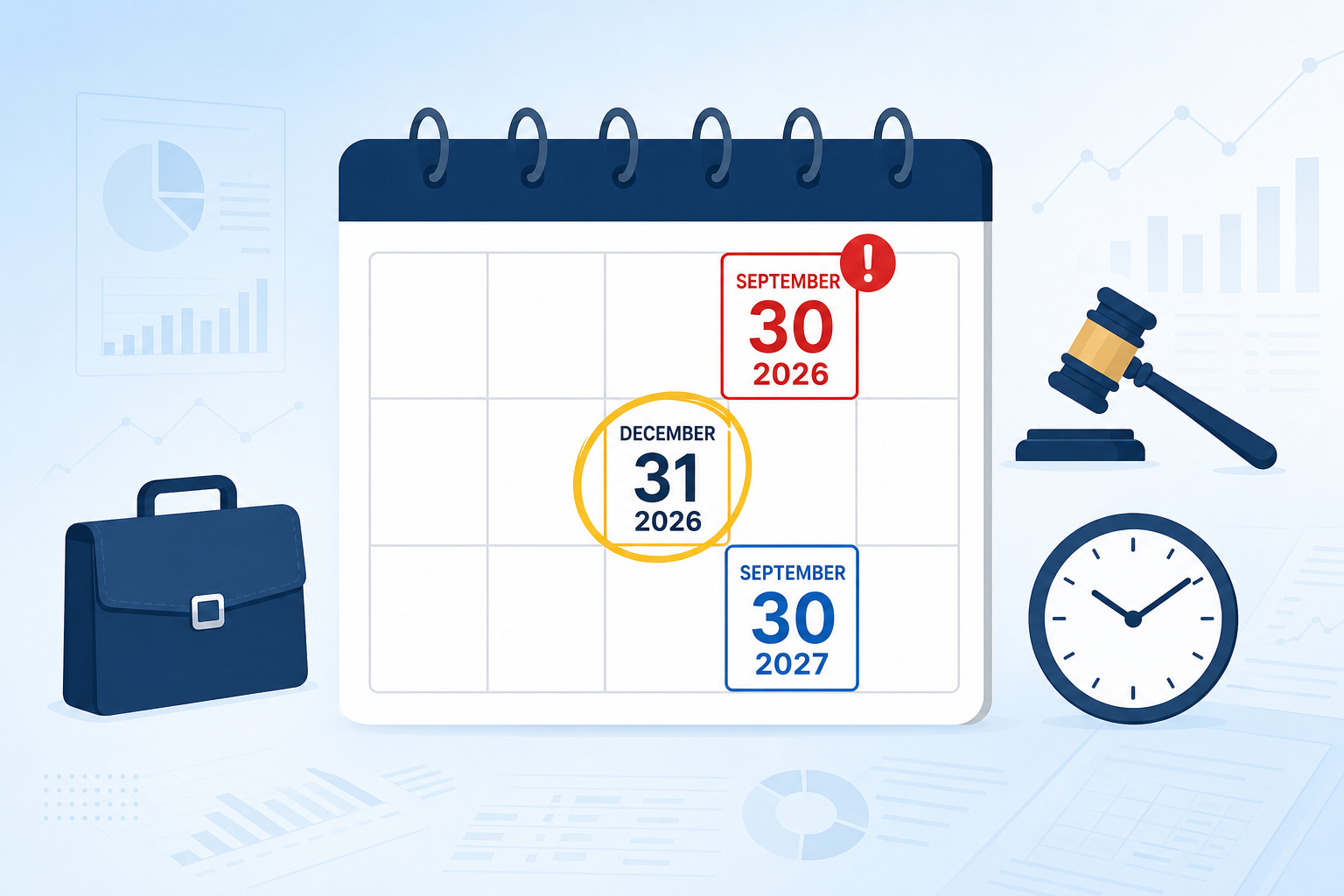
The Regional Center Program is currently authorized through September 30, 2027. September 30, 2026, is instead an important grandfathering deadline. The next major date is December 31, 2026, because the EB-5 minimum investment amounts are scheduled to be adjusted for inflation beginning January 1, 2027.
For investors who are already confident that they intend to pursue EB-5, the safest approach is to file before September 30, 2026, in order to receive the explicit grandfathering protection provided under the current law. However, EB-5 will remain available after September 30.
The EB-5 Reform and Integrity Act of 2022, commonly known as the RIA, reauthorized the Regional Center Program and established September 30, 2026, as a grandfathering deadline.
Under the RIA, investors who properly file their EB-5 petitions on or before September 30, 2026, are protected if the Regional Center Program later expires. USCIS must continue adjudicating qualifying petitions filed by the deadline even if the program is subsequently suspended or is not reauthorized.
This does not guarantee that an individual petition will be approved. Investors must still satisfy all EB-5 requirements, including documenting the lawful source and path of their investment capital. However, it provides clear statutory protection against one particular risk: a future lapse in the Regional Center Program.
That distinction is important. Filing before September 30 does not eliminate every immigration or investment risk, but it gives the investor the strongest and clearest protection available under the current EB-5 law.
No. Investors will still be able to invest in EB-5 projects and file I-526E petitions after September 30, 2026.
The Regional Center Program itself remains authorized through September 30, 2027. September 30, 2026, is therefore not the expiration date of the program. It is the final date currently identified in the statute for investors to receive its explicit grandfathering protection.
An investor filing after September 30 may still ultimately receive protection if Congress extends the deadline, reauthorizes the program, or adopts new grandfathering legislation. The EB-5 industry is actively advocating for such an extension.
Historically, when EB-5 has faced an expiration date or an increase in the minimum investment amount, the general assumption has been that investors who filed under the law in effect at the time would not lose their pending cases merely because the law later changed. That principle provides some comfort to investors filing after September 30.
Nevertheless, there is an important difference between believing that investors are likely to be protected and having that protection expressly written into the current statute. As the law stands today, petitions filed by September 30, 2026, receive the clearest statutory protection.
My view is therefore straightforward: if you are confident that you intend to pursue EB-5, it is better to file before September 30 rather than rely on Congress to address the issue later.
September 30 is the filing deadline, but it should not be treated as the date to begin preparing an EB-5 case.
For many investors, the most time-consuming part of the process is documenting the lawful source and path of the $800,000 investment. Depending on how the capital was accumulated, the documentation may involve employment income, business earnings, property sales, investments, gifts, inheritance, loans, or a combination of several sources.
Under normal circumstances, preparing the source-of-funds documentation and completing an I-526E petition can take at least one month. Complicated cases can take considerably longer.
The expected surge in filings before September 30 creates an additional challenge. Thousands of investors may attempt to file during the final weeks before the deadline, and many experienced EB-5 immigration attorneys are already managing substantial caseloads. Banks, translators, accountants, project sponsors, and other professionals involved in the filing process may also face delays.
Starting earlier gives the investor and immigration attorney more time to identify missing documents, trace transfers, resolve inconsistencies, complete translations, and prepare a petition that is both timely and properly documented.
It also reduces the risk of being caught behind a large wave of last-minute filings. Although USCIS does not always adjudicate petitions in strict filing order, filing earlier generally establishes an earlier priority date and may improve an investor’s position if the relevant visa category later becomes backlogged.
The next important deadline after September 30 is December 31, 2026.
Under the RIA, the EB-5 minimum investment amounts are scheduled to be adjusted for inflation beginning January 1, 2027. The current minimum investment is $800,000 for projects located in a targeted employment area, including qualifying rural and high-unemployment areas, and for qualifying infrastructure projects. The standard minimum investment amount is currently $1,050,000.
The precise new amounts have not yet been officially established. However, the EB-5 industry generally expects the targeted employment area investment to rise to at least $900,000, with the possibility of a higher amount depending on the final inflation calculation. The law requires periodic inflation adjustments, with the first scheduled for January 1, 2027.
This creates a second incentive for investors to act before the end of 2026.
Demand may initially decline after the September 30 grandfathering deadline, particularly among investors who accelerated their filings to receive statutory protection. However, we expect another increase in demand as December 31 approaches and investors seek to qualify under the current $800,000 investment requirement.
Therefore, an investor who misses September 30 may still have a meaningful reason to file before December 31.
September 30, 2027, is the date on which the current authorization of the EB-5 Regional Center Program is scheduled to expire unless Congress extends or reauthorizes it.
This is different from the September 30, 2026, grandfathering deadline.
The distinction can be summarized as follows:
Even if Congress takes no action before September 30, 2026, the program will remain operational for another year. Investors can continue selecting qualifying projects, making investments, and filing I-526E petitions during that period.
For Indian & Chinese investors, the grandfathering deadline is important, but visa availability may be an even more immediate reason to move forward.
The September 2026 Visa Bulletin shows that the EB-5 rural, high-unemployment, and infrastructure set-aside categories remain current for Indian & mainland-born Chinese applicants. The unreserved EB-5 category, by contrast, remains subject to a cutoff date.
When a category is current, a qualified investor does not have to wait for a priority date to become available before an immigrant visa can be issued or an adjustment-of-status application can be approved.
For investors already lawfully present in the United States, current visa availability can create an additional opportunity. Subject to individual eligibility and the monthly chart designated by USCIS, an investor may be able to file Form I-485 concurrently with Form I-526E.
A pending adjustment-of-status application may allow the investor and qualifying family members to apply for employment authorization and advance parole while their EB-5 cases are pending. This can be especially valuable for individuals currently relying on H-1B, L-1, F-1, or another temporary immigration status.
If the category later retrogresses, a properly filed I-485 generally remains pending. The applicant may normally continue renewing employment and travel authorization, although USCIS cannot approve the adjustment application until a visa number is available again.
This does not make the applicant a permanent resident while the I-485 is pending, and travel or employment decisions should always be reviewed with immigration counsel. Nevertheless, concurrent filing can provide significant practical benefits while the investor waits for adjudication and visa availability.
Current visa availability is not guaranteed to continue indefinitely.
Demand for post-RIA EB-5 set-aside visas has increased substantially, particularly in the rural category. If demand exceeds the number of visas available, the Department of State may establish a cutoff date for Indian & Chinese applicants. The September 2026 Visa Bulletin specifically notes that categories can retrogress or become unavailable when demand approaches annual limits.
Once a cutoff date is established, new applicants may lose the immediate ability to file Form I-485 concurrently with Form I-526E. Investors outside the United States may also face a longer wait before completing immigrant visa processing through a U.S. consulate.
No one can predict the exact month in which retrogression will occur. However, investors should understand that the present period of visa availability is an opportunity that may not remain open indefinitely.
The short answer is that investors who are confident they will pursue EB-5 should aim to file before September 30, 2026. Doing so provides the explicit grandfathering protection contained in the current law and removes uncertainty about whether Congress will extend that protection to later filings.
At the same time, September 30 should not be misrepresented as the end of EB-5. The Regional Center Program remains authorized through September 30, 2027, and investors can continue investing and filing petitions after the 2026 grandfathering deadline.
For investors who do not file by September 30, the next important date will be December 31, 2026, before the scheduled inflation adjustment to the minimum investment amounts.
The three dates represent three different issues:
Investors should not make a rushed decision simply because a deadline is approaching. EB-5 is a major financial and immigration commitment that requires careful review of the project, offering documents, immigration strategy, and source of funds.
However, investors who have already decided that EB-5 is the right path should not wait until the final weeks before September 30 to begin. Starting the process now provides more time to prepare a complete petition, reduces the risk of last-minute delays, and gives the investor the best chance of obtaining the protections and immigration benefits currently available.
Learn more about our currently available projects.
Learn more about EB5 Visa Investors as a company.
This article is provided for general informational purposes and does not constitute legal, tax, or investment advice. Prospective investors should consult qualified immigration counsel and other professional advisers regarding their individual circumstances.