.png?width=1906&height=652&name=Logo%20Pill%20Blue%20(2026_03_27%2017_45_45%20UTC).png)

EB-5 Retrogression
EB-5 Data
EB-5 EAD
.png?width=48&height=48&name=eb5%20visa%20investors%20favicon%20(2026_03_28%2019_48_32%20UTC).png)
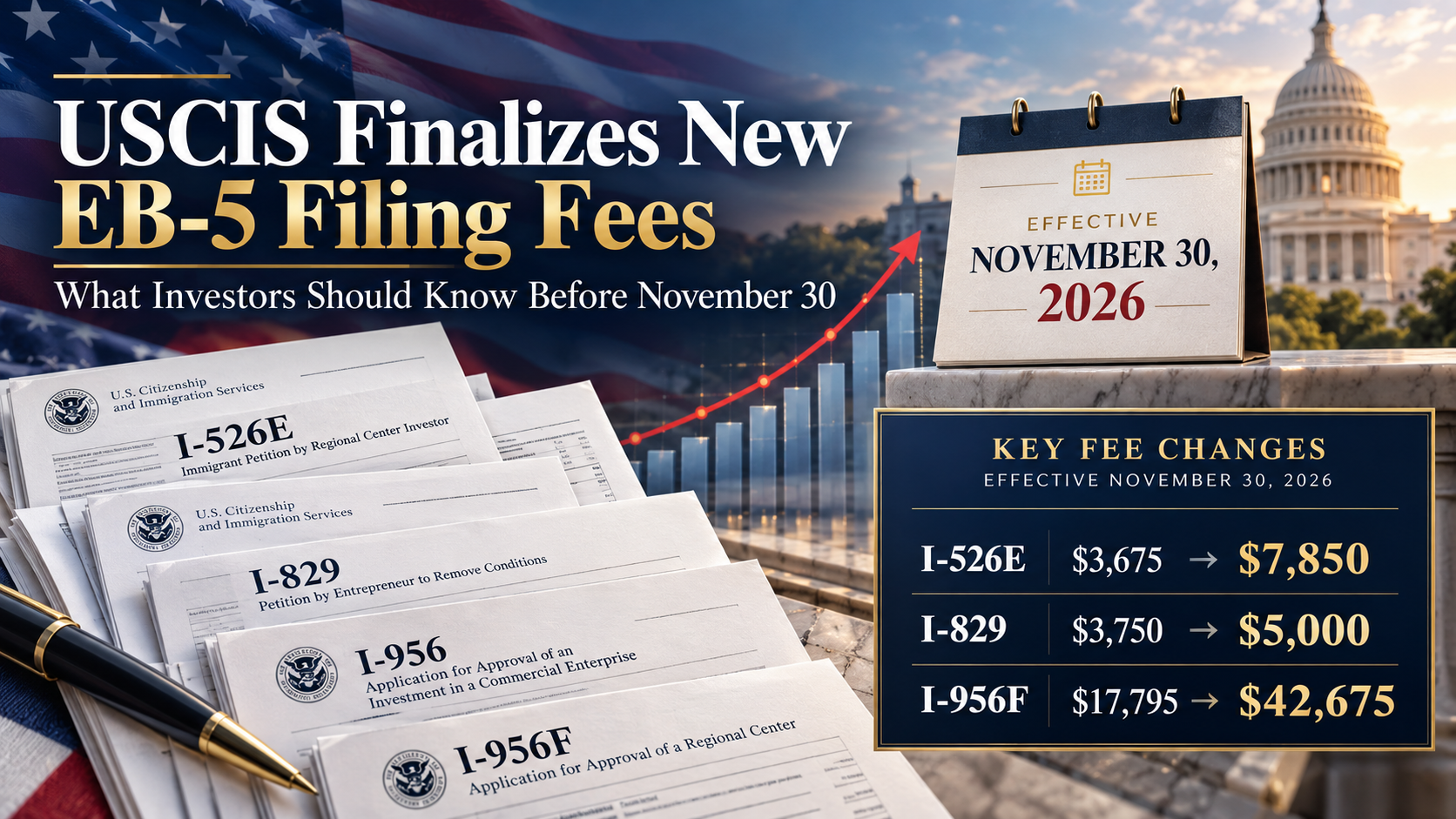
USCIS has finalized a new EB-5 fee schedule that will materially change the government filing costs associated with the program beginning November 30, 2026.
For prospective regional center investors, the most important number is the Form I-526E filing fee. The cost of an initial I-526E petition will increase from the $3,675 fee USCIS currently collects to $7,850, an increase of $4,175, or approximately 114%. The separate EB-5 Integrity Fund fee paid with an I-526E filing will also increase from $1,000 to $1,100.
Combined, the principal USCIS charges associated with a new regional center investor's I-526E filing will rise from approximately $4,675 today to $8,950 beginning November 30.
That is an additional $4,275 in government filing costs.
Importantly, this does not change the statutory $800,000 minimum investment for qualifying targeted employment area and infrastructure investments. The new rule changes USCIS filing and program administration fees, not the underlying EB-5 investment requirement.
For families already preparing to enter the EB-5 process, November 30 therefore represents a measurable economic deadline.
Understanding the regulatory history is important because investors reviewing the October 2025 proposed rule may see materially different figures.
When DHS published its Notice of Proposed Rulemaking on October 23, 2025, the EB-5 fees then formally in effect included a $11,160 I-526E filing fee, a $9,525 I-829 fee, and $47,695 fees for Forms I-956 and I-956F. Against that fee structure, DHS actually proposed reductions, including a $9,625 initial I-526E fee and a $29,935 I-956F fee.
Then the regulatory landscape changed.
On November 12, 2025, the U.S. District Court for the District of Colorado stayed certain EB-5 fees imposed by the 2024 USCIS fee rule. USCIS subsequently reverted to the substantially lower fees that had been in effect before April 1, 2024. As a result, the baseline against which the final 2026 rule must be measured is very different from the baseline used when DHS issued its 2025 proposal.
DHS then updated its EB-5 fee study using newer FY 2026 and FY 2027 workload and cost assumptions, replacing the FY 2024/2025 projections underlying the proposed rule. The agency expressly states that these updated budget and workload estimates are a principal reason the final fees differ from the proposal.
This means it would be incomplete simply to say that USCIS “reduced” its proposed $9,625 I-526E fee to $7,850.
The final fee is lower than the proposal, but the intervening court ruling changed the existing fee baseline and DHS subsequently recalculated the program's expected costs and filing volumes.
For an initial regional center investor petition:
| Stage | I-526E Fee |
|---|---|
| 2024 fee schedule in effect when NPRM was developed | $11,160 |
| October 2025 proposed fee | $9,625 |
| Current fee after court-ordered reversion | $3,675 |
| Final fee effective Nov. 30, 2026 | $7,850 |
The October 2025 proposal also contemplated a $95 technology fee as part of the initial petition charge. The final rule reduces that technology component to $75, which is already included in the final $7,850 I-526E fee.
The final rule affects substantially more than I-526E petitions. DHS has revised fees across investor petitions, regional center filings, promoter registrations and Integrity Fund assessments. (USCIS)
| Filing or Fee | Current Fee | Oct. 2025 Proposed Fee | Final Fee Nov. 30, 2026 | Change vs. Current |
|---|---|---|---|---|
| Form I-526 – Standalone Investor* | $3,675 | $9,625 | $7,615 | +$3,940 / +107% |
| Form I-526E – Initial Regional Center Investor* | $3,675 | $9,625 | $7,850 | +$4,175 / +114% |
| Form I-526E – Amendment | $3,675 | $9,530 | $7,775 | +$4,100 / +112% |
| Form I-527 – Amendment to Legacy I-526 | $0 / new form | $8,000 | $10,330 | New fee |
| Form I-829 – Removal of Conditions | $3,750 | $7,860 | $5,000 | +$1,250 / +33% |
| Form I-956 – Initial Regional Center Designation | $17,795 | $28,895 | $44,115 | +$26,320 / +148% |
| Form I-956 – Amendment | $17,795 | $18,480 | $9,835 | -$7,960 / -45% |
| Form I-956F – Project Application | $17,795 | $29,935 | $42,675 | +$24,880 / +140% |
| Form I-956G – Regional Center Annual Statement | $3,035 | $2,740 | $2,165 | -$870 / -29% |
| Form I-956H – Bona Fides of Persons Involved | $0 | $55 | $65 | New fee |
| Form I-956K – Promoter Registration | $0 | $2,740 | $2,165 | New fee |
| I-526E Integrity Fund Fee | $1,000 | $1,085 | $1,100 | +$100 / +10% |
| RC Integrity Fund – 20 or fewer investors | $10,000 | $10,825 | $11,000 | +$1,000 / +10% |
| RC Integrity Fund – more than 20 investors | $20,000 | $21,650 | $22,000 | +$2,000 / +10% |
*The final initial I-526 and I-526E figures already include the new $75 EB-5 Technology Fee. The Integrity Fund assessment is separate.
The final regulation itself confirms the $7,615 standalone I-526 fee, $7,850 initial I-526E fee, $7,775 I-526E amendment fee, $10,330 I-527 fee, $5,000 I-829 fee, $44,115 initial I-956 fee, $9,835 I-956 amendment fee, $42,675 I-956F fee, $2,165 I-956G fee and $65 I-956H fee.
The final rule also increases the I-526E Integrity Fund assessment to $1,100 and the regional center annual Integrity Fund assessments to $11,000 and $22,000, respectively.
The fee increase is tied directly to the post-2022 structure of the EB-5 program.
The EB-5 Reform and Integrity Act directed DHS to conduct a program-specific fee study and establish fees sufficient to fund administration of the modernized program. According to the final rule, DHS now projects approximately $105 million in annual EB-5 program costs, compared with approximately $56.6 million in revenue under the current fee schedule, leaving a projected annual funding gap of roughly $48.4 million.
The agency says these costs include activities such as:
Across approximately 16,600 projected annual EB-5 filings, DHS calculates that fees for existing forms will increase by a weighted average of approximately 70.7%, or about $2,945.90 per filing.
This is therefore not simply an inflation adjustment. It is an attempt to recalibrate the cost of operating the EB-5 program under the considerably more compliance-intensive structure created after 2022.
For most investors, the immediate calculation is relatively straightforward.
Current I-526E filing fee: $3,675
Current Integrity Fund fee: $1,000
Combined: $4,675
New I-526E filing fee: $7,850
New Integrity Fund fee: $1,100
Combined: $8,950
$4,275
The final rule states that any application, petition or request postmarked on or after November 30, 2026 must include the new fees.
For an investor whose project selection, source-of-funds documentation and petition preparation are already substantially complete, that creates a clear economic consideration.
It does not create a reason to rush into an unsuitable investment.
Some of the largest increases fall on regional centers and project sponsors.
The filing fee for a new Form I-956F project application increases from $17,795 to $42,675, an increase of approximately 140%.
The fee for an initial Form I-956 regional center designation increases from $17,795 to $44,115, approximately 148%.
At the same time, not every fee increases.
The I-956 regional center amendment fee falls to $9,835, and the I-956G annual statement fee falls to $2,165. DHS specifically chose to differentiate initial I-956 filings from amendments after commenters argued that amendments may require less extensive review in some circumstances.
The broader economic consequence is worth watching.
A $42,675 I-956F filing fee materially raises the upfront cost of bringing a new EB-5 offering to market. That could have a disproportionate effect on smaller projects and sponsors, although whether it ultimately reduces the number or diversity of projects offered to investors remains a market question rather than an established consequence of the rule.
The new fee schedule should also be viewed in the context of the EB-5 Reform and Integrity Act.
The modern program carries substantially greater regulatory infrastructure than the pre-2022 version. This includes enhanced project review, promoter registration, regional center oversight, audits, site visits and additional fraud-prevention responsibilities.
USCIS is now explicitly charging program participants to fund that infrastructure.
For investors, higher filing costs are obviously a negative from a pure expense perspective. But the expenses are being assessed within a program that now operates with considerably more formalized compliance mechanisms than it did historically.
That does not guarantee that a project is safe, that an investor will receive immigration approval or that capital will be repaid.
It does mean that the regulatory framework surrounding EB-5 has become more institutionalized.
The final rule also creates an EB-5-specific technology assessment.
DHS originally proposed a $95 technology fee. After revising its fee study using FY 2026 and FY 2027 projections, the agency reduced the final amount to $75.
That $75 charge is incorporated into the initial I-526 and I-526E filing fees rather than added on top of the stated $7,615 and $7,850 amounts.
DHS says the revenue will support improvements to the information technology systems used to administer EB-5. Investors should not interpret the technology fee, or the broader fee increase, as a guarantee of any particular adjudication timeline.
The October 2025 proposal contemplated an 8.25% inflation adjustment to Integrity Fund fees, which would have increased the investor assessment from $1,000 to $1,085 and the regional center assessments to $10,825 and $21,650.
For the final rule, DHS changed the measurement period used for inflation and adopted a 10% increase instead.
Accordingly:
This is another example of why the October 2025 proposal should not be used as the current fee schedule.
The September 2026 final rule controls.
For investors already nearing filing readiness, the new rule creates an objective cost advantage to completing the process before November 30.
Avoiding approximately $4,275 in additional USCIS charges is meaningful. However, the fee deadline should remain subordinate to more important considerations.
An $800,000 EB-5 investment should still be evaluated based on factors such as:
The rational conclusion is therefore not “file at any cost before November 30.”
It is:
If your diligence is complete, your project has been selected and your immigration counsel is prepared to file, waiting beyond November 30 now carries a clearly defined additional cost.
The final fee rule provides another useful indication of the direction EB-5 has taken since passage of the Reform and Integrity Act.
The program now includes formalized I-956F project review, enhanced regional center supervision, promoter registration, Integrity Fund assessments, audits, site visits and greater compliance obligations.
The administrative cost of that infrastructure is increasingly being borne directly by the investors, regional centers and other market participants who use the program.
For sophisticated investors, the result is a notable tradeoff:
EB-5 is becoming materially more expensive to administer at the same time that its regulatory infrastructure is becoming more developed.
Higher fees should not be confused with lower investment risk, faster adjudication or a guaranteed immigration outcome.
But they do signal that USCIS is building a substantially more resource-intensive regulatory framework around the program.
For prospective regional center investors, the three most important figures are straightforward:
November 30, 2026
The new fee schedule becomes effective.
$7,850
The new initial I-526E filing fee, including the $75 technology assessment.
$8,950
The combined initial I-526E filing fee and $1,100 Integrity Fund assessment.
Compared with today's combined $4,675 cost, that represents an additional $4,275 in USCIS charges.
The regulatory history is equally important. The final 2026 fees should not be confused with the October 2025 proposal because a subsequent federal court ruling restored the lower pre-2024 EB-5 fees and DHS then rebuilt its fee study using updated FY 2026 and FY 2027 projections.
For investors evaluating EB-5 today, the fee deadline should therefore be treated as one factor within a broader decision.
Select the right project. Complete the diligence. Prepare the petition correctly.
And if those steps are already complete, recognize that November 30 now has a very real price attached to it.
U.S. Department of Homeland Security / U.S. Citizenship and Immigration Services, U.S. Citizenship and Immigration Services Employment-Based Immigrant Visa, Fifth Preference (EB-5) Fee Rule, Final Rule, 91 Fed. Reg. 61940, September 30, 2026.
U.S. Department of Homeland Security / U.S. Citizenship and Immigration Services, U.S. Citizenship and Immigration Services Employment-Based Immigrant Visa, Fifth Preference (EB-5) Fee Rule, Notice of Proposed Rulemaking, October 23, 2025.
This article is provided for general informational purposes only and does not constitute immigration, legal, securities, tax or investment advice. Prospective investors should consult independent immigration counsel and other professional advisers regarding their individual circumstances.
The new USCIS EB-5 fee schedule takes effect on November 30, 2026. Petitions or applications postmarked on or after that date must include the new filing fees.
For investors who are already prepared to file, this creates a clear timing consideration because the initial I-526E-related government fees will be materially higher after the effective date.
The initial Form I-526E filing fee will increase from $3,675 to $7,850. In addition, the EB-5 Integrity Fund fee associated with an I-526E filing will increase from $1,000 to $1,100.
That means the combined initial USCIS cost for a regional center investor will increase from approximately $4,675 to $8,950.
No. The new fee rule does not change the $800,000 minimum investment amount for qualifying TEA and infrastructure projects.
The increase applies to USCIS filing and program administration fees, not to the statutory EB-5 investment amount itself.
USCIS states that the higher fees are intended to recover the full cost of administering the EB-5 program under the post-2022 regulatory framework.
Those costs include adjudication, fraud detection, audits, site visits, regional center oversight, compliance reviews, technology improvements and other integrity measures required under the EB-5 Reform and Integrity Act.
Not necessarily. Avoiding approximately $4,275 in additional initial USCIS fees can be economically meaningful, but it should not override proper due diligence or petition preparation.
Investors should still prioritize project quality, job-creation coverage, capital structure, visa availability, source and path of funds, and legal readiness. For investors who have already completed those steps, however, filing before November 30 can reduce the government filing cost under the current fee schedule.
U.S. Citizenship and Immigration Services, “USCIS Adjusts EB-5 Fees to Cover Program Costs and Strengthen Integrity Measures,” September 29, 2026. (USCIS)
Department of Homeland Security / U.S. Citizenship and Immigration Services, “U.S. Citizenship and Immigration Services Employment-Based Immigrant Visa, Fifth Preference (EB-5) Fee Rule,” Final Rule, published September 30, 2026. (DHS)
This article is provided for general informational purposes only and does not constitute immigration, legal, securities, tax or investment advice. Investors should consult their independent immigration counsel and other professional advisers regarding their individual circumstances.