.png?width=1906&height=652&name=Logo%20Pill%20Blue%20(2026_03_27%2017_45_45%20UTC).png)
Cairnspring Mills
EB-5 Due Diligence
.png?width=48&height=48&name=eb5%20visa%20investors%20favicon%20(2026_03_28%2019_48_32%20UTC).png)
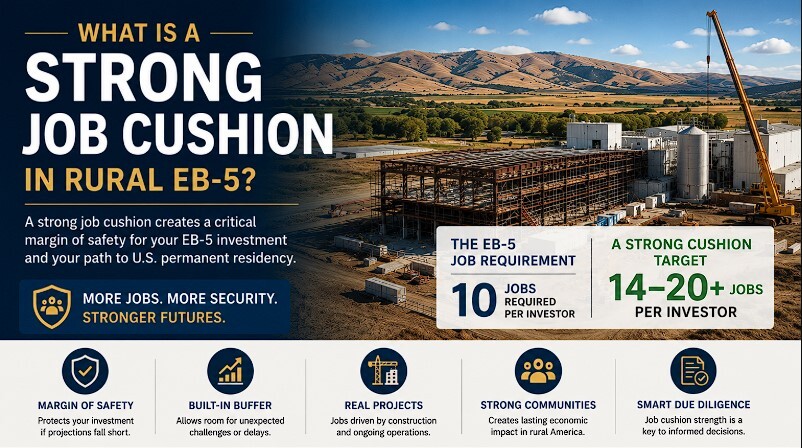
A job cushion refers to the excess jobs an EB-5 project creates above the 10 full-time U.S. jobs required per investor. USCIS mandates that each EB-5 investor must demonstrate their capital contributed to the creation of at least 10 qualifying jobs.
When a project generates more than this minimum, the extra jobs form a protective buffer. This buffer exists to absorb potential shortfalls if economic projections don't fully materialize.
For example, if a project's economic analysis predicts 15 jobs per investor, the job cushion is 5 jobs. That means even if job creation falls 33% short of projections, you would still meet the 10-job threshold.
Your conditional green card depends on proving that your investment generated 10 jobs. At the I-829 removal of conditions stage, USCIS examines whether the project actually created these jobs.
Projects with thin job margins leave little room for unexpected challenges. Economic downturns, construction delays, or operational changes can all reduce job counts below initial estimates.
A strong job cushion acts as insurance for your immigration outcome. It means the project can experience some level of underperformance and still deliver the jobs you need for permanent residency.
Rural EB-5 projects, which fall under the Targeted Employment Area (TEA) designation, can count indirect and induced jobs alongside direct employment. This methodology often results in higher total job counts.
Direct jobs are positions created directly by the project, such as on-site employees. Indirect jobs come from increased business activity in the supply chain, like vendors and service providers.
Induced jobs result from the spending of direct and indirect employees in the local economy. A qualified economist prepares a job creation report using USCIS-approved methodologies to calculate all three categories.
Many rural EB-5 projects generate a significant portion of their job count from construction activity. These jobs are counted based on the total project expenditures during the building phase.
Operational jobs come from the ongoing business once construction is complete. Projects with secured revenue streams or off-take agreements often have more reliable operational job projections. EB5 Visa Investors focuses on projects where construction is fully financed and operational revenue is substantiated by third-party analysis.
There is no official USCIS definition for a "strong" job cushion. However, experienced investors and immigration professionals generally consider certain thresholds as meaningful protection.
A project that creates at least 14 jobs per investor offers a 40% buffer over the 10-job requirement. This margin allows the project to fall short by nearly half and still satisfy immigration requirements.
Some institutional-grade projects target 15 to 20 jobs per investor. At these levels, even substantial underperformance would not jeopardize your ability to remove conditions on your green card.
Before investing, ask for the project's economic impact study and review the total jobs projected per investor. Confirm whether the economist used USCIS-accepted methodologies like RIMS II or IMPLAN.
Ask what percentage of jobs come from construction versus ongoing operations. Construction jobs are typically more predictable because they're based on already-committed expenditures.
Determine whether any jobs have already been created or if all job counts are projections. Existing jobs carry less uncertainty than purely forward-looking estimates.
At EB5 Visa Investors, evaluating job cushion strength is central to our project selection process. We look for rural EB-5 projects where job creation projections include meaningful margins for error.
Our approach prioritizes projects with a minimum of 14 jobs per investor, with most of those jobs derived from construction spending or secured operational revenue. This framework helps reduce the immigration risk tied to speculative business performance.
We also verify that independent economists prepared the job creation reports and that construction financing is fully in place. These factors contribute to more reliable job creation outcomes.
Be cautious of projects where the job count barely exceeds the 10-job minimum. A project estimating 11 or 12 jobs per investor leaves almost no room for any shortfall.
Watch for job projections that rely heavily on speculative revenue assumptions. If a project's operational jobs depend on business performance that hasn't been validated, those jobs carry higher uncertainty.
Also question whether the economic model has been reviewed or updated recently. Outdated reports may not reflect current economic conditions or project changes.
Rural EB-5 projects currently receive priority processing from USCIS for I-526E petitions. This accelerated timeline is one reason rural investments have become more attractive to investors.
However, priority processing does not change the job creation requirement. You still must demonstrate 10 jobs per investor at the I-829 stage, regardless of how quickly your I-526E was approved.
Investors drawn to rural projects for faster processing should still perform thorough job cushion analysis. Speed to approval should not come at the expense of immigration safety.
A strong job cushion is one of the most important factors in protecting your EB-5 immigration outcome. It represents the margin of safety between projected job creation and the minimum required for green card approval.
When evaluating rural EB-5 projects, look for investments that generate at least 14 jobs per investor from sources that are already financed or secured. This approach reduces the risk that your green card application depends on uncertain business outcomes.
EB5 Visa Investors helps investors navigate these complex decisions by focusing on projects where job creation margins align with an investor-first philosophy.
Each EB-5 investor must demonstrate that their investment contributed to the creation of at least 10 full-time U.S. jobs. This is a USCIS requirement for both the initial I-526E petition and the I-829 removal of conditions.
A well-structured rural EB-5 project typically creates at least 14 jobs per investor. EB5 Visa Investors looks for projects with this minimum threshold to help ensure your investment meets immigration requirements even if projections fall short.
Regional center EB-5 projects can count direct, indirect, and induced jobs. Direct jobs are positions at the project itself. Indirect and induced jobs result from supply chain activity and employee spending in the local economy.
At the I-829 stage, you must prove that your investment created the required jobs. A strong job cushion means the project can underperform its projections and still satisfy USCIS requirements. EB5 Visa Investors prioritizes this margin of safety in its project evaluation.
Yes, construction jobs count toward job creation in regional center projects. These jobs are calculated based on total construction expenditures using approved economic methodologies. Projects with construction already underway often have more reliable job counts.
No, priority processing for rural EB-5 projects only affects petition processing times. The 10-job-per-investor requirement remains the same. EB5 Visa Investors advises investors to prioritize job cushion analysis even when attracted to faster processing timelines.