

Donald Trump’s Trump Gold Card initiative has sparked both intrigue and skepticism—particularly among savvy prediction market participants.
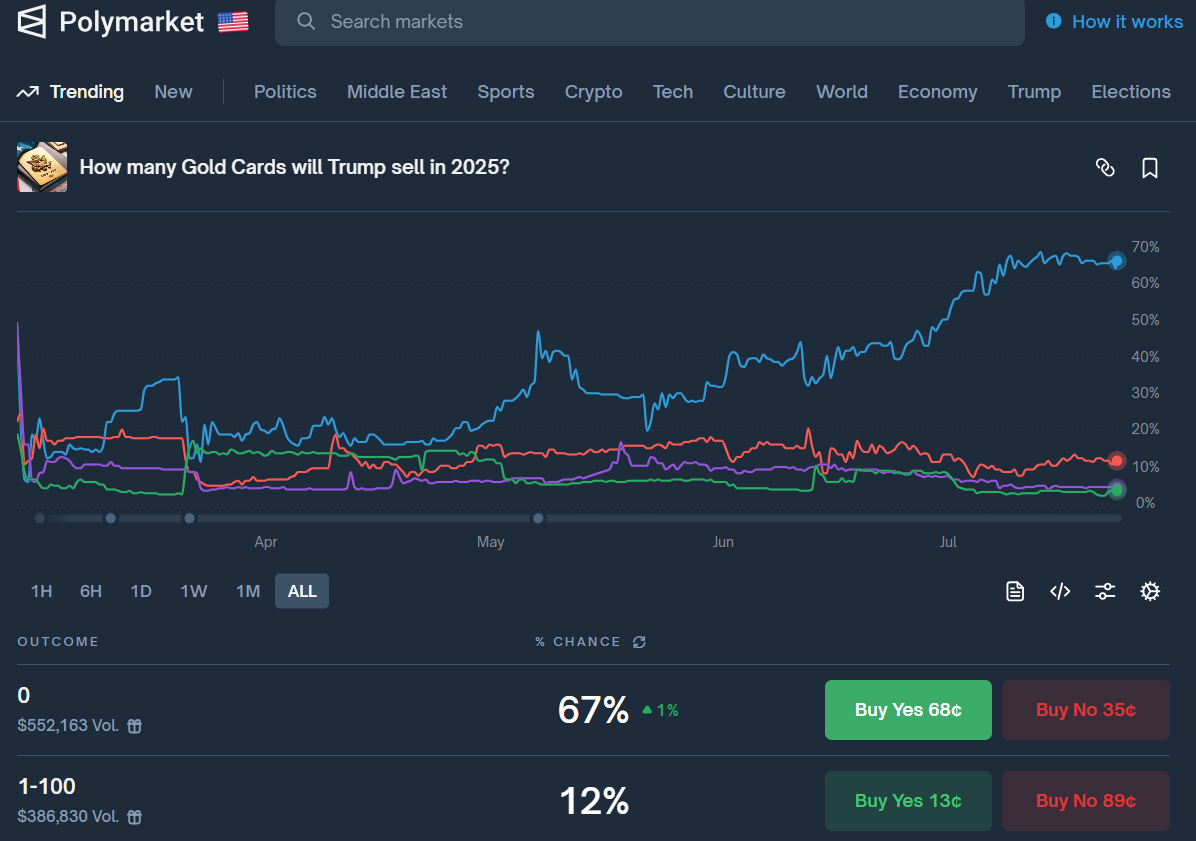
According to a current Polymarket market, 67% of traders are betting that Trump will sell zero Gold Cards in 2025. Yes, you read that right—zero. Despite the official launch of TrumpCard.gov, and open invitations for foreign nationals to join the waitlist, many still believe this project won’t take off.
Let’s explore why.
TrumpCard.gov Is Live—And Accepting Foreign Signups
TrumpCard.gov launched recently with sleek branding and an unmistakable message: this is your chance to get something exclusive. The site promises access, status, and an undisclosed set of benefits tied to Trump’s political and business ambitions.
Interestingly, the waitlist explicitly allows foreign nationals to sign up. That alone raises some questions:
hanks to early disclosures, we now know the minimum investment will be $5 million so it’s clearly intended for ultra-high-net-worth individuals seeking the benefits of being a U.S. permanent resident.
What remains unclear, however, are the details that matter most:
- Will the $5 million investment function more like a donation, or will investors receive equity, returns, or tangible benefits in exchange?
- Will Gold Card investors enjoy faster processing than traditional EB-5 visa applicants, potentially bypassing visa backlogs and lengthy adjudication timelines?
- Will these investors be granted a special residency status exempt from taxation on worldwide income, unlike EB-5 green card holders who are subject to full U.S. tax liability?
Until those answers are made public, the Trump Gold Card will continue to raise eyebrows—not just in political circles, but among serious global investors comparing it to well-established immigration options like the EB-5 visa.

What Does This Mean for EB-5 Investors?
If you’re a serious investor looking to secure a U.S. green card, its still difficult to see how the Trump Gold Card would be a better option when it comes at a $5 million price tag. Here’s how the EB-5 visa stacks up:
- Requires an $800,000 investment into a qualifying project in a Targeted Employment Area (TEA)
- Must create at least 10 full-time U.S. jobs
- Leads to conditional green card and, eventually, permanent residence
- Regulated by USCIS under the EB-5 Reform and Integrity Act of 2022
- Transparent documentation, offering memorandums, and legal protection
By contrast, the Trump Gold Card is still undefined. It has no published investment framework, no guaranteed benefit, and—at least so far—no formal connection to a legal immigration path.
Conclusion: Flash or Substance?
The Trump Gold Card introduces a high-dollar immigration offering outside traditional channels, but critical policy questions remain unanswered. While the $5 million price tag and foreign waitlist access suggest it’s more than a vanity product, the absence of regulatory clarity, legal structure, or defined immigration benefits raises valid concerns.
By comparison, the EB-5 visa program offers a long-standing, legally codified pathway to permanent residency. It operates under a well-defined framework with specific requirements around job creation, investment amount, and USCIS oversight.
Until further details emerge, investors weighing the Trump Gold Card against EB-5 should consider not just cost—but certainty, compliance, and the long-term implications of each route.
For those who are truly looking to move to the United States, invest in a TEA, and get a green card faster than 90 days (via concurrent filing under the EB-5 program), the safe, proven route is still the USCIS-approved EB-5 visa.
Ready to Make a Real Investment in America?
If you’re asking:
- How to get EB5 visa?
- Can I get loan for EB5 visa?
- Is EB5 worth it?
…Click here to read through our EB-5 FAQs.
👉 Click here to explore our current EB-5 offerings
We help foreign investors legally obtain U.S. green cards through real estate-backed EB-5 projects in high-demand rural and high-unemployment Targeted Employment Areas.
