EB-5 Due Diligence

An in-depth comparison of immigration eligibility, investment costs, processing timelines, visa retrogression, family benefits, and the strategic considerations shaping permanent residency decisions.
For international professionals, entrepreneurs, and investors seeking permanent residency in the United States, EB-2 and EB-5 offer two fundamentally different routes to achieving the same long-term objective: a U.S. green card.
The EB-2 program focuses on advanced education, exceptional professional ability, and employment-based qualifications. The EB-5 Immigrant Investor Program offers an alternative based on qualifying investment capital and the creation of American jobs.
Both can lead to permanent residency for eligible applicants and their families. However, differences in eligibility requirements, employer sponsorship, application procedures, financial commitments, and visa availability can dramatically influence the overall immigration experience.
These distinctions are especially important in late 2026, as EB-2 applicants confront continuing visa backlogs while qualifying EB-5 reserved categories remain current worldwide.
Which pathway makes the most sense for your qualifications, financial resources, career goals, and family?
Let's examine the advantages, limitations, and critical details every prospective applicant should understand.
| Key Consideration | EB-2 | EB-5 |
|---|---|---|
| Primary eligibility | Advanced degree or exceptional ability | Qualifying capital investment and job creation |
| Required capital investment | None | $800,000 or $1,050,000 |
| Employer sponsorship | Generally required; NIW exemption | Not required |
| PERM labor certification | Usually required; NIW exempt | Not required |
| Self-petitioning | Available through NIW | Available |
| Primary USCIS petition | Form I-140 | Form I-526 or I-526E |
| Job creation obligation | No investor job-creation requirement | At least 10 qualifying full-time jobs |
| Professional credentials | Central to eligibility | No particular degree or professional distinction required |
| Investment risk | No mandatory business investment | Substantial capital at risk |
| Visa availability in October 2026 | Backlogged worldwide | Reserved categories current worldwide |
| Initial green card | Nonconditional permanent residence | Two-year conditional permanent residence |
| Family eligibility | Qualifying spouse and children | Qualifying spouse and children |
| Major obstacle | Eligibility, sponsorship, PERM, and visa retrogression | Capital requirements, source of funds, project risk, and job creation |
The essential trade-off: EB-2 generally requires far less financial commitment, but its eligibility requirements and visa backlogs can introduce substantial uncertainty. EB-5 requires significantly more capital and financial due diligence, but offers greater independence from employers and currently favorable visa availability through its reserved categories.
The EB-2 employment-based second-preference category provides a route to permanent residency for individuals with advanced professional qualifications.
Applicants generally qualify under one of two classifications:
Advanced-degree professionals: Individuals with a qualifying advanced degree or its equivalent. In applicable circumstances, a bachelor's degree followed by at least five years of progressive post-baccalaureate experience can satisfy the advanced-degree equivalency requirement.
Individuals of exceptional ability: Applicants who demonstrate expertise significantly above that ordinarily encountered in the sciences, arts, or business.
However, meeting EB-2 educational or professional qualifications does not necessarily eliminate the need for a sponsoring employer.
For most traditional EB-2 applications, a U.S. employer must sponsor the foreign professional and complete labor-certification requirements through the Department of Labor.
The process generally involves obtaining a prevailing-wage determination, conducting required recruitment, documenting the labor-market test, and submitting a PERM labor-certification application.
The employer then files Form I-140 with USCIS.
This process is intended to protect the U.S. labor market by establishing that there are insufficient qualified, available, and willing U.S. workers for the particular position, and that employment of the foreign worker will not adversely affect similarly employed U.S. workers.
The National Interest Waiver (NIW) provides an important alternative for eligible professionals and entrepreneurs.
An NIW applicant may self-petition without obtaining employer sponsorship or PERM labor certification.
To qualify, applicants must establish their underlying EB-2 eligibility and demonstrate that:
An NIW can therefore offer considerable flexibility to entrepreneurs, researchers, scientists, engineers, and other qualified professionals.
However, NIW approval does not eliminate EB-2 visa-number backlogs. NIW applicants remain subject to the same underlying EB-2 visa allocation and priority-date framework.
Best suited for: Qualified professionals with strong credentials, eligible employers, or nationally important endeavors who prefer to avoid substantial capital investment.
The EB-5 Immigrant Investor Program was established to encourage capital investment and job creation in the United States.
Unlike EB-2, EB-5 does not require advanced educational credentials, extraordinary professional achievements, or sponsorship from a U.S. employer.
Instead, investors must satisfy specific financial, immigration, and job-creation requirements.
To qualify, an investor must generally:
An investor's spouse and unmarried children under 21 may also qualify for derivative immigration benefits, subject to applicable age-protection rules.
| EB-5 Investment Category | Minimum Investment | Reserved Visa Allocation |
|---|---|---|
| Rural targeted employment area | $800,000 | 20% |
| High-unemployment targeted employment area | $800,000 | 10% |
| Qualifying infrastructure project | $800,000 | 2% |
| Standard investment outside eligible reduced-investment categories | $1,050,000 | Unreserved |
These reserved allocations are an important component of the EB-5 Reform and Integrity Act of 2022.
The legislation created distinct visa pools intended to support qualifying investment in rural communities, high-unemployment locations, and certain public infrastructure projects.
As of October 2026, all three EB-5 reserved visa categories remain current worldwide, including for applicants chargeable to India and mainland China.
This does not guarantee expedited petition approval or prevent future retrogression, but it represents a meaningful difference in present visa availability.
Investors generally choose between direct investment and participation through a designated regional center.
Direct investment may suit entrepreneurs who wish to own or operate their own U.S. businesses. These investments generally rely on qualifying direct employment to meet the job-creation requirement.
Regional center investment typically allows investors to participate in pooled investment structures supporting larger commercial developments. Qualifying indirect employment may be counted through accepted economic methodologies.
Depending on the structure, regional center investors may have limited day-to-day operational responsibilities.
However, investor participation through a regional center does not eliminate financial risk, USCIS documentation requirements, or the need for independent due diligence.
Best suited for: Financially qualified investors who seek an employer-independent immigration option and can tolerate the financial and procedural risks associated with EB-5 investment.
One of the clearest distinctions between EB-2 and EB-5 is the financial commitment.
However, it is important to distinguish nonrefundable immigration expenses from EB-5 investment capital, which represents a financial asset subject to possible gains or losses.
| Expense | EB-2 | EB-5 |
|---|---|---|
| Minimum required investment | None | $800,000–$1,050,000 |
| Initial immigrant petition | I-140: $715 plus applicable additional fee | I-526E: $3,675 before Nov. 30, 2026 |
| Additional initial program fee | Applicable I-140 Asylum Program Fee | $1,000 investor Integrity Fund fee before Nov. 30 |
| Optional premium processing | $2,965 | Not available for I-526/I-526E |
| Legal expenses | Often several thousand dollars; complex NIWs cost more | Substantial immigration and source-of-funds preparation expenses |
| Project administration expenses | Not applicable | Frequently tens of thousands of dollars for regional center offerings |
| Additional residency filings | Adjustment/consular and family fees | Adjustment/consular, family, and later I-829 fees |
| Investment principal at risk | No mandatory investment | Yes |
Fees shown reflect October 2026 rules. Legal and project administration expenses vary substantially. All-in EB-5 administrative, legal, immigration, and related expenses may exceed $50,000–$100,000 beyond principal, depending on the offering and family circumstances.
For EB-2 cases involving PERM, employers generally must pay their own labor-certification recruitment and associated employer legal expenses.
By contrast, EB-5 investors must generally fund the investment, project-related expenses, immigration representation, and their individual filings.
The distinction matters.
The $800,000 minimum EB-5 investment is not simply a government immigration charge. It represents capital invested in a qualifying enterprise.
Depending on the project's business structure, the investment may eventually be repaid. Some offerings may provide limited investment returns.
However, neither repayment nor profit is guaranteed. The amount and timing of any distribution depend on project performance, contractual terms, financing, liquidity, and applicable legal requirements.
Prospective investors should never assume that a successful immigration petition guarantees the return of their capital.
Processing speed is often among the most important considerations for families seeking to relocate, establish careers, or plan their children's education in the United States.
Unfortunately, immigration timelines are frequently misunderstood.
An approved immigrant petition is not the same as an available immigrant visa or an issued green card.
A complete immigration timeline includes petition preparation, USCIS adjudication, visa availability, and adjustment of status or consular processing.
For traditional employer-sponsored EB-2, the process can include several months of prevailing-wage and recruitment preparation, followed by PERM certification and I-140 adjudication.
The Department of Labor reported an average of 336 calendar days for PERM analyst-review determinations in its August 2026 data.
This does not include the full prevailing-wage and recruitment process.
Eligible traditional EB-2 I-140 petitions can use 15-business-day premium processing. NIW petitions can use premium processing with a 45-business-day USCIS action period.
However, visa backlogs may remain long after approval of the petition.
EB-5 applicants file Form I-526 for qualifying standalone investments or Form I-526E for regional center investments.
USCIS historical statistics through August 2026 reported an 11.5-month median processing time for completed I-526E petitions and 28.3 months for completed standalone I-526 petitions.
These figures describe cases adjudicated during the reporting period, not guaranteed waiting times for new applications.
After obtaining an immigrant visa number, eligible investors complete consular processing or adjustment of status to become two-year conditional permanent residents.
The investor subsequently files Form I-829 to remove conditions.
| Route | Broad Planning Scenario | Important Qualification |
|---|---|---|
| Traditional EB-2 | 2–4+ years in less-backlogged situations | Significant backlogs can extend the wait by many years |
| EB-2 NIW | 1.5–4+ years where visas become available | I-140 approval does not bypass EB-2 retrogression |
| Reserved EB-5 | 2–5+ years to conditional residence as a broad planning scenario | Varies with petition adjudication, visa movement, and final processing |
| EB-5 removal of conditions | Additional period following conditional residence | I-829 processing can continue beyond the two-year conditional period |
These ranges are illustrative planning scenarios, not official government predictions, averages, or commitments. Cases can move faster or considerably slower.
A qualified EB-5 applicant may benefit from a currently available reserved visa number even when the initial EB-5 petition itself takes longer than a premium-processed EB-2 I-140.
The relevant question is not simply, "Which petition gets approved first?" It is "Which immigration pathway offers the most workable overall path to residency for this particular applicant?"
Visa retrogression occurs when demand for immigrant visas exceeds the available supply under applicable annual or country-based limits, leading to restrictive priority-date cutoffs.
EB-2 has experienced substantial demand from highly qualified professionals, including large populations of applicants born in India and mainland China.
Although EB-2 applicants may have approved petitions, many cannot receive permanent residence until their priority dates become eligible for final action.
| Visa Category | Most Countries | Mainland China | India |
|---|---|---|---|
| EB-2 | Jan. 1, 2025 | Oct. 1, 2021 | Nov. 1, 2013 |
| EB-5 Unreserved | Current | Dec. 1, 2016 | Dec. 1, 2023 |
| EB-5 Rural | Current | Current | Current |
| EB-5 High-Unemployment | Current | Current | Current |
| EB-5 Infrastructure | Current | Current | Current |
Source: U.S. Department of State, October 2026 Visa Bulletin. Dates are Final Action Dates, not projected future processing dates. "Most Countries" refers to the All Chargeability Areas Except Those Listed column; Mexico and the Philippines share the displayed EB-2 date for this month.
These figures illustrate an important strategic difference.
An Indian-born professional pursuing EB-2 faces a final-action cutoff extending back to November 2013. Meanwhile, an otherwise eligible Indian-born investor pursuing a qualifying reserved EB-5 category currently faces no final-action cutoff.
However, a priority-date cutoff does not tell an applicant precisely how many years remain until visa issuance. Visa availability can advance, retrogress, or become unavailable based on changing demand and annual allocations.
The EB-5 Reform and Integrity Act establishes allocations for three categories of qualifying investments:
These allocations create distinct visa pools separate from the unreserved category.
For applicants from countries with significant EB-2 backlogs, a qualifying reserved-category EB-5 investment may represent an important alternative.
Nevertheless, current availability should never be mistaken for permanent immunity from retrogression.
Both EB-2 and EB-5 can support derivative immigration applications for qualifying spouses and unmarried children under 21.
However, the timing and flexibility of those benefits can differ considerably based on visa availability and the applicant's existing immigration circumstances.
Eligible applicants lawfully present in the United States may be able to file Form I-485 concurrently with their underlying immigrant petitions when visa availability and all applicable adjustment requirements permit it.
This option can be especially relevant to EB-5 reserved-category investors, given their current visa availability.
For eligible applicants with pending I-485 applications, separate applications may be submitted for:
EB-2 applicants can potentially access these same adjustment-related benefits when they become eligible to file I-485.
Filing I-485 does not itself provide employment authorization, establish an independent nonimmigrant status, or guarantee admission after international travel.
Advance parole generally must be approved before travel, and reentry remains subject to inspection and government discretion.
Applicants should obtain individualized legal advice concerning maintenance of lawful status, travel, employment authorization, and any effect on family members.
For parents with children approaching age 21, extended visa backlogs can create additional planning considerations.
Child Status Protection Act provisions may preserve eligibility in qualifying circumstances, but their application can be complex.
Whether pursuing EB-2 or EB-5, families should evaluate immigration timing with the circumstances of every dependent—not only the principal applicant—in mind.
Step 1 — Confirm professional and job eligibility. Establish the qualifying degree or exceptional ability and determine the employer's sponsorship requirements.
Step 2 — Obtain prevailing-wage determination. The sponsoring employer initiates the required wage assessment.
Step 3 — Complete recruitment. The employer conducts applicable recruitment and labor-market testing.
Step 4 — Submit PERM certification. The employer files the labor-certification application with the Department of Labor.
Step 5 — File Form I-140. Following PERM approval, the employer submits the immigrant petition.
Step 6 — Monitor visa availability. The applicant must satisfy the applicable priority-date and filing requirements.
Step 7 — Obtain permanent residence. Complete I-485 adjustment or immigrant visa processing through a U.S. consulate.
Step 1 — Establish underlying EB-2 eligibility.
Step 2 — Define a qualifying proposed endeavor.
Step 3 — Collect evidence supporting all three NIW requirements.
Step 4 — Self-petition using Form I-140.
Step 5 — Monitor the EB-2 Visa Bulletin and priority date.
Step 6 — Complete I-485 adjustment or consular processing when eligible.
Step 1 — Evaluate immigration eligibility and financial capacity. Assess minimum investment requirements and lawful source-of-funds evidence.
Step 2 — Select an appropriate project. Review regional center status, project documents, developer credentials, capital structure, business feasibility, and job-creation estimates.
Step 3 — Complete independent due diligence. Evaluate business risks, financial disclosures, collateral arrangements, repayment provisions, and the proposed exit strategy.
Step 4 — Make the qualifying investment. Complete subscription and investment procedures in accordance with the offering documents and applicable EB-5 rules.
Step 5 — Prepare and file Form I-526E. Submit the investor petition with documentation establishing eligibility and lawful capital sources.
Step 6 — Pursue conditional permanent residency. When eligible, complete adjustment of status or consular processing.
Step 7 — Monitor investment and job creation. Maintain the documentation necessary for the immigration process.
Step 8 — File Form I-829. Seek removal of conditions during the 90-day period immediately preceding the second anniversary of conditional residency.
Investors pursuing qualifying standalone investments generally use Form I-526 rather than I-526E.
Prospective investors evaluating EB-5 against EB-2 should understand two approaching financial milestones.
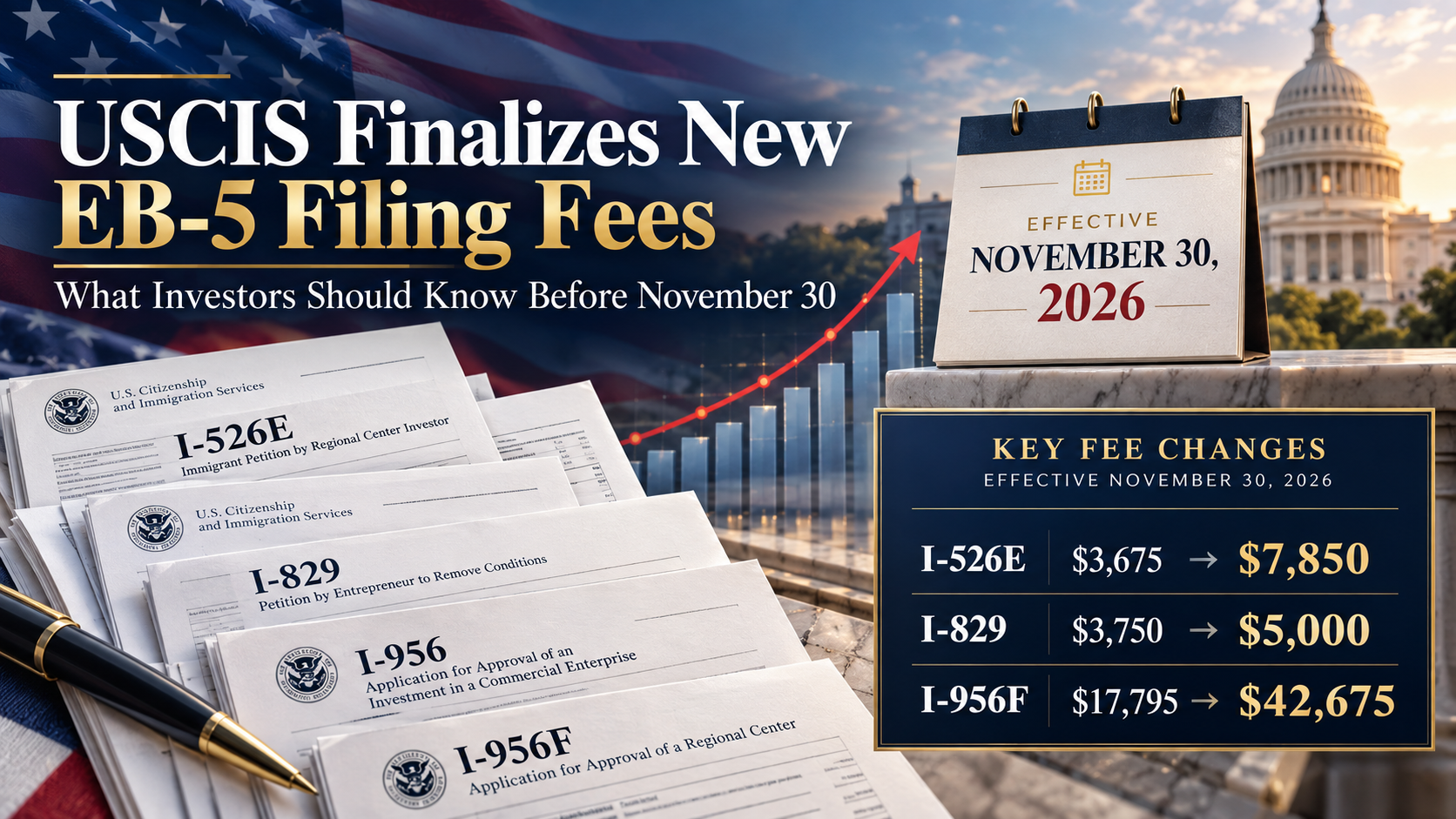
The Department of Homeland Security finalized new EB-5 program fees effective November 30, 2026.
For a regional center investor, the initial I-526E petition fee increases from $3,675 to $7,850, while the separate investor Integrity Fund fee increases from $1,000 to $1,100.
The resulting initial combined government fees increase from $4,675 to $8,950, excluding other immigration expenses.
Under the EB-5 Reform and Integrity Act, the minimum investment amounts are scheduled to adjust for inflation beginning January 1, 2027.
Consequently, the current $800,000 and $1,050,000 minimums may not apply to new petitions filed after the adjustment takes effect.
The precise future amounts should be confirmed using the applicable legal requirements and official guidance at the time of filing.
The September 30, 2026 statutory protection deadline for qualifying regional center petitions has already passed.
The Regional Center Program remains authorized through September 30, 2027, under current legislation, but investors filing after the grandfathering deadline should seek advice concerning the scope of available protections and any future authorization uncertainty.
These developments make immigration timing an important financial consideration—but should never replace thorough legal and investment due diligence.
Consider how these circumstances may influence the decision.
Scenario A: A qualified professional with employer sponsorship
An applicant with an advanced degree, an established U.S. employer, and manageable priority-date circumstances may find traditional EB-2 the most financially practical option.
Potential preference: EB-2, particularly where the employer is willing to manage sponsorship costs and long-term employment remains attractive.
Scenario B: A researcher or entrepreneur pursuing a nationally important endeavor
A qualified individual without an employer may benefit from the flexibility of an NIW petition. However, approval of the NIW cannot overcome the underlying EB-2 visa backlog.
Potential preference: EB-2 NIW, provided the applicant meets the evidentiary criteria and can accommodate the visa timeline.
Scenario C: A financially qualified investor facing a prolonged EB-2 backlog
A professional born in a country with substantial EB-2 oversubscription may value EB-5's independent eligibility requirements and currently available reserved visa numbers.
Potential preference: Reserved-category EB-5, subject to capital suitability, project due diligence, and comprehensive legal review.
Scenario D: A family prioritizing employment independence
An investor who seeks to avoid dependence on a sponsoring employer or a specific occupation may find EB-5 appealing, especially where timely eligibility to file adjustment applications is strategically important.
Potential preference: EB-5, where its benefits justify the substantial capital commitment and investment risk.
These examples are illustrative. Neither program is universally superior, and the best choice must account for personal qualifications, country of chargeability, existing immigration status, financial capacity, and family circumstances.
It can be, particularly for applicants facing significant EB-2 visa-number backlogs who qualify for a currently available EB-5 reserved category.
However, EB-5 petition adjudication, conditional-residence processing, and the possibility of future visa retrogression mean that no universal speed advantage can be guaranteed.
Reserved EB-5 categories currently provide substantially more favorable visa availability for applicants chargeable to India and mainland China.
That advantage may be significant for qualifying investors, but it must be evaluated against investment risk, lawful-funds requirements, and individual processing circumstances.
Potentially, yes. An eligible applicant may pursue a separate EB-5 petition while maintaining an existing EB-2 case.
However, each petition must independently satisfy its requirements, and any request to transfer the underlying basis of a pending adjustment application requires careful legal consideration. A priority date is not automatically transferable between EB-2 and EB-5.
Yes, where the applicant qualifies for a National Interest Waiver. However, the waiver does not remove the underlying EB-2 qualifications or provide exemption from EB-2 visa-number limitations.
Potentially, depending on the project and offering structure. However, repayment is not guaranteed.
EB-5 capital must meet the applicable at-risk requirements, and investors should independently evaluate financial performance, redemption restrictions, business risks, and exit provisions.
Eligible applicants who have filed Form I-485 may apply for employment authorization. The relevant authorization generally must be approved before beginning work unless the applicant already possesses another valid basis for employment.
An EB-5 investor's qualifying spouse and unmarried children under 21 can also seek derivative permanent residency. Age-out protections may apply to certain children, but eligibility must be assessed individually.
The investor ordinarily holds conditional permanent resident status for two years and must timely file Form I-829 to request removal of conditions.
Eligibility depends on meeting applicable investment and job-creation requirements. A timely, properly filed petition can extend conditional status while the government adjudicates the removal request.
An inflation adjustment is scheduled to begin January 1, 2027. Investors should verify the applicable amount for their filing date rather than assuming today's minimums will continue unchanged.
EB-2 and EB-5 can both support the long-term objective of establishing permanent residence in the United States, but their relative advantages depend heavily on the applicant.
For professionals with strong credentials, eligible employers, or qualifying national-interest endeavors, EB-2 can provide an accessible immigration pathway without requiring major investment capital.
For financially qualified investors, EB-5 offers a distinctly different proposition: the ability to pursue permanent residency without employer sponsorship, while supporting job creation and economic development in the United States.
In the current immigration environment, the availability of reserved EB-5 visa numbers represents an important consideration for applicants affected by EB-2 retrogression, particularly those facing lengthy priority-date backlogs.
Nevertheless, an EB-5 petition should never be viewed merely as a way to purchase faster immigration processing. Appropriate project selection, lawful source-of-funds documentation, capital protection considerations, and realistic repayment expectations remain essential.
The most effective immigration strategy is one that balances visa availability, financial exposure, professional independence, family priorities, and long-term opportunity.
For individuals considering alternatives to extended employer-sponsored immigration pathways, a qualifying EB-5 investment may merit closer evaluation.
Explore available EB-5 investment opportunities and learn how project selection, reserved visa categories, lawful capital documentation, and individualized immigration planning may contribute to your family's long-term U.S. residency objectives.
Request an EB-5 eligibility and investment consultation to explore your options.
Disclaimer: This article is provided for educational purposes as of October 23, 2026. It does not constitute legal, immigration, financial, securities, or investment advice. USCIS processing times, visa availability, fees, and program requirements may change. Readers should consult qualified immigration counsel and appropriate independent investment advisers before proceeding.