.png?width=1906&height=652&name=Logo%20Pill%20Blue%20(2026_03_27%2017_45_45%20UTC).png)
Sept 30th EB-5 Grandfathering
.png?width=48&height=48&name=eb5%20visa%20investors%20favicon%20(2026_03_28%2019_48_32%20UTC).png)
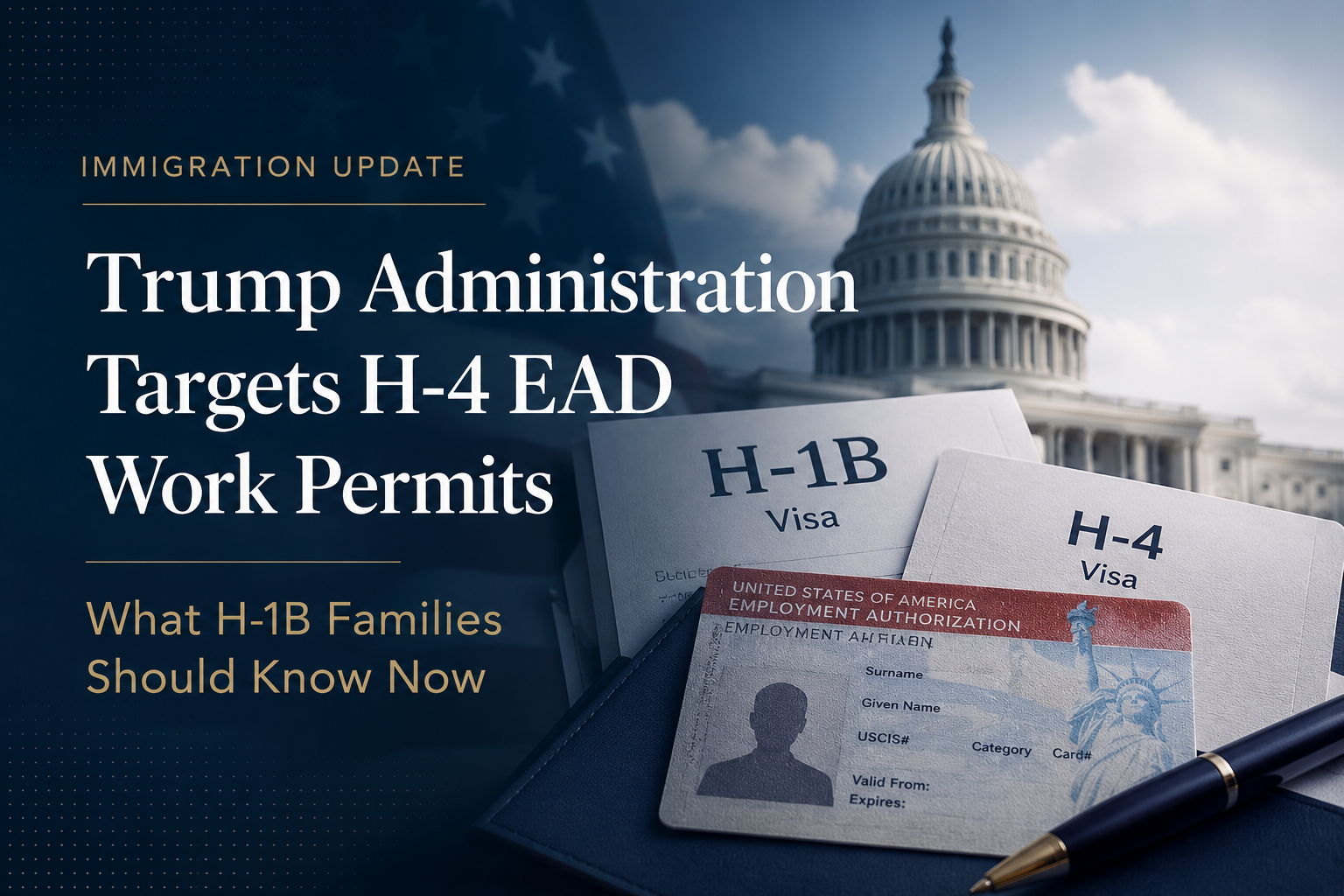
The Trump administration has revived a major immigration policy issue that could affect thousands of H-1B families in the United States: whether certain H-4 spouses should continue to qualify for employment authorization.
According to the federal regulatory agenda, DHS/USCIS has listed a proposed rule titled “Removing H-4 Dependent Spouses From the Classes of Noncitizens Eligible for Employment Authorization.” The abstract states that DHS is proposing to remove certain H-4 dependent spouses of H-1B workers from the class of individuals eligible to request employment authorization under the (c)(26) category, effectively reversing the 2015 rule that created H-4 EAD eligibility.
Importantly, this does not mean H-4 EAD has already been cancelled. The regulatory agenda currently lists the proposal as a Long-Term Action, with the NPRM publication date marked “To Be Determined.”
The H-1B visa is a temporary, employer-sponsored, nonimmigrant work visa for foreign professionals in specialty occupations. In practical terms, it is commonly used by U.S. employers to hire workers in fields such as technology, engineering, finance, healthcare, research, and other professional occupations requiring specialized knowledge.
H-1B status is tied to the sponsoring employer and the approved position. This means the worker’s ability to remain employed in the United States generally depends on maintaining valid H-1B status through an eligible employer.
The H-4 visa is the dependent visa category for certain family members of H visa holders, including spouses and unmarried children under 21 of H-1B workers. The H-4 visa allows qualifying dependents to live in the United States while the principal H-1B worker maintains valid status.
However, H-4 status by itself does not automatically authorize employment. Work authorization for H-4 spouses depends on separate eligibility rules.
An Employment Authorization Document, or EAD, is a work permit issued by USCIS. For H-4 spouses, the relevant category is commonly referred to as the H-4 EAD or (c)(26) EAD.
Under current rules, certain H-4 spouses may apply for employment authorization if the principal H-1B worker has reached a qualifying stage in the employment-based green card process, such as having an approved Form I-140 or qualifying for H-1B extensions under AC21.
Before 2015, H-4 dependent spouses generally could not work in the United States simply by virtue of holding H-4 status. This created a difficult situation for many skilled immigrant families, especially those stuck in long employment-based green card backlogs.
In February 2015, DHS published a final rule extending employment authorization eligibility to certain H-4 spouses of H-1B workers who were seeking employment-based lawful permanent resident status. The rule became effective on May 26, 2015.
The policy rationale was straightforward: DHS wanted to reduce economic hardship for H-1B families, improve retention of highly skilled workers, and support families who were already far along in the employment-based green card process but waiting years for immigrant visa availability.
The rule has been controversial for years. During the first Trump administration, DHS also pursued efforts to rescind H-4 EAD eligibility, but those efforts were not finalized. More recently, a long-running legal challenge to the H-4 EAD rule ended after the U.S. Supreme Court declined to review the case on October 14, 2025, leaving in place lower court decisions that had upheld DHS authority to authorize employment for certain H-4 spouses.
The newly listed rule, RIN 1615-AD14, would seek to remove certain H-4 dependent spouses from the categories eligible to request employment authorization. Bloomberg Law reported that the administration is planning a rule to eliminate work authorization eligibility for spouses of H-1B workers, and noted that the agenda entry did not identify a target release date.
If ultimately finalized, the rule could significantly affect H-1B families, particularly Indian families, who make up a large share of the H-1B population. USCIS data for FY2024 shows that 71% of approved H-1B petitions were for beneficiaries born in India.
For many H-4 spouses, an EAD is not simply a convenience. It can represent professional identity, financial independence, household stability, and the ability to continue building a career while the family waits for permanent residence.
Without H-4 employment authorization, many spouses would likely be unable to work unless they independently qualify for another employment-authorized status, such as their own H-1B, L-1, O-1, F-1 OPT/STEM OPT, or another qualifying category.
For families already facing long green card backlogs, this potential change adds another layer of uncertainty to long-term U.S. immigration planning.
At this stage, there is no immediate filing deadline created by the agenda listing itself.
The key dates to watch are:
1. NPRM publication date — To Be Determined
The current RegInfo entry lists the proposed rule as a long-term action and states that the NPRM date is “To Be Determined.” It also lists no legal deadline for publication.
2. Public comment deadline — Not yet available
Once DHS publishes a Notice of Proposed Rulemaking in the Federal Register, the notice should include a public comment period. The exact comment deadline will not be known until the NPRM is published.
3. Final rule publication — Unknown
After the comment period closes, DHS must review comments before issuing any final rule. There is no fixed deadline requiring DHS to finalize the rule by a specific date.
4. Effective date — usually after final publication
Under the Administrative Procedure Act, substantive rules generally must be published at least 30 days before their effective date, unless an exception applies. The 2015 H-4 EAD final rule, for example, was published in February 2015 and became effective on May 26, 2015.
For now, H-4 EAD eligibility remains in place. Families should avoid panic, but they should also take the proposal seriously.
H-1B and H-4 families may want to speak with immigration counsel about:
Whether the H-4 spouse is currently eligible to file or renew an EAD;
Whether a renewal should be filed as early as permitted;
Whether the spouse may qualify for an independent work-authorized visa category;
Whether the principal H-1B worker’s green card process is properly documented and advancing;
Whether the family should consider longer-term immigration strategies less dependent on employer sponsorship.
The proposed H-4 EAD rollback is not yet law. It is not yet a published proposed rule. Existing H-4 EAD rules remain in effect unless and until DHS completes the formal rulemaking process and a final rule becomes effective.
Still, the policy signal is significant.
For H-1B families, especially those facing long employment-based green card backlogs, this development is a reminder that U.S. immigration planning should not rely on a single fragile pathway. Employment authorization, visa status, green card timing, and family financial planning are deeply connected.
Families affected by this issue should monitor the rulemaking closely and work with experienced immigration counsel before making employment, travel, or long-term immigration decisions.
The H-4 EAD is an employment authorization document that allows certain H-4 spouses of H-1B workers to legally work in the United States. Under current rules, an H-4 spouse may qualify if the principal H-1B worker has an approved I-140 immigrant petition or has received certain H-1B extensions under AC21 while pursuing employment-based permanent residence.
No. The H-4 EAD has not been eliminated. DHS has listed a proposed rule titled “Removing H-4 Dependent Spouses From the Classes of Noncitizens Eligible for Employment Authorization,” but the rule is currently listed as a long-term action, and the Notice of Proposed Rulemaking publication date is still to be determined.
DHS published the final H-4 EAD rule on February 25, 2015, extending employment authorization eligibility to certain H-4 dependent spouses of H-1B workers pursuing employment-based lawful permanent residence. The rule became effective on May 26, 2015.
If finalized, the rule could affect certain H-4 spouses of H-1B workers who currently qualify for employment authorization under the (c)(26) category. The practical impact would likely be greatest for families waiting in long employment-based green card backlogs, especially where the H-4 spouse depends on the EAD for employment, income, or career continuity.
Families should not assume an immediate change, but they should monitor the rulemaking process closely. The key dates to watch are the publication of the proposed rule, the public comment deadline, the final rule publication date, and the effective date. For now, eligible H-4 spouses may want to speak with immigration counsel about timely EAD filings or renewals, alternative visa options, and longer-term immigration planning.