.png?width=1906&height=652&name=Logo%20Pill%20Blue%20(2026_03_27%2017_45_45%20UTC).png)
Cairnspring Mills
EB-5 Due Diligence
.png?width=48&height=48&name=eb5%20visa%20investors%20favicon%20(2026_03_28%2019_48_32%20UTC).png)
The at-risk requirement is one of the most misunderstood aspects of the EB-5 program. USCIS requires that your capital be deployed in a new commercial enterprise with a genuine possibility of loss and a genuine opportunity for gain. This means your money cannot simply sit in a bank account—it must fund job-creating business activities.
What the at-risk rule does not mean: Your investment must be reckless or unprotected. Several types of protections are permitted under USCIS guidance, and knowing which ones comply can significantly reduce your exposure.
An I-526E denial refund clause allows the regional center to return your capital if USCIS denies your petition. Because this protection is tied to your immigration eligibility rather than project performance, it satisfies the at-risk requirement.
A borrower repayment arrangement to the new commercial enterprise (NCE) is also permitted. In a loan model, the developer can commit to repaying the NCE—not you as the individual investor. This adds a layer of credit quality to the project structure.
Construction completion bonds backed by a surety or parent company can protect your immigration case by helping ensure the project finishes and creates the jobs you need for I-829 approval.
Any arrangement that promises a fixed-date return of your capital or a specific rate of return violates the at-risk standard. Projects that offer "unconditional repayment" or side letters promising definite returns on a specific date will likely trigger an I-526E denial.
Project failure is the central risk in EB-5 investing, but the consequences depend heavily on when the failure occurs. EB5 Visa Investors encourages prospective investors to understand each scenario before committing capital.
If the project fails while your I-526E petition is still pending, USCIS will analyze whether a "material change" has occurred. A construction halt, developer default, or business closure typically triggers a Request for Evidence or Notice of Intent to Deny. If the change is fatal to the petition's merits, denial follows.
Your financial recovery depends on whether capital was held in escrow or already deployed. If funds remained in escrow pending petition approval, you may recover them minus administrative fees. If they were already released to the project, recovery depends on the project's remaining assets and your position in the capital stack.
This scenario intersects immigration and financial risk most sharply. If your project fails after you receive conditional permanent residency but before your I-829 filing, your green card is not automatically revoked.
USCIS has recognized through policy guidance that investor status can be preserved if jobs were created and capital remained at risk throughout the conditional period. The agency evaluates whether you sustained the investment as required—not whether the project was commercially successful.
Redeployment is a mechanism introduced under USCIS policy to address a specific problem: What happens when a project completes and returns capital before your I-829 petition is approved?
Under EB-5 rules, your capital must remain at risk until USCIS removes the conditions on your green card. If the developer repays the NCE before that point, the regional center must redeploy your funds into a new qualifying investment. Otherwise, you risk an I-829 denial for failing to maintain the at-risk requirement.
When a project matures, the regional center typically invests returned capital into another EB-5 project or qualifying securities like U.S. Treasuries. The redeployment must satisfy the same regulatory standards as your original investment.
Investors in visa backlog categories—particularly from China and India—may face extended redeployment periods lasting years. This is one reason why EB5 Visa Investors emphasizes understanding redeployment terms before you commit capital.
Before investing, ask the regional center: What is your redeployment policy? What types of investments do you use during redeployment? How will you notify investors when redeployment occurs? A reputable regional center will have clear, written answers to these questions.
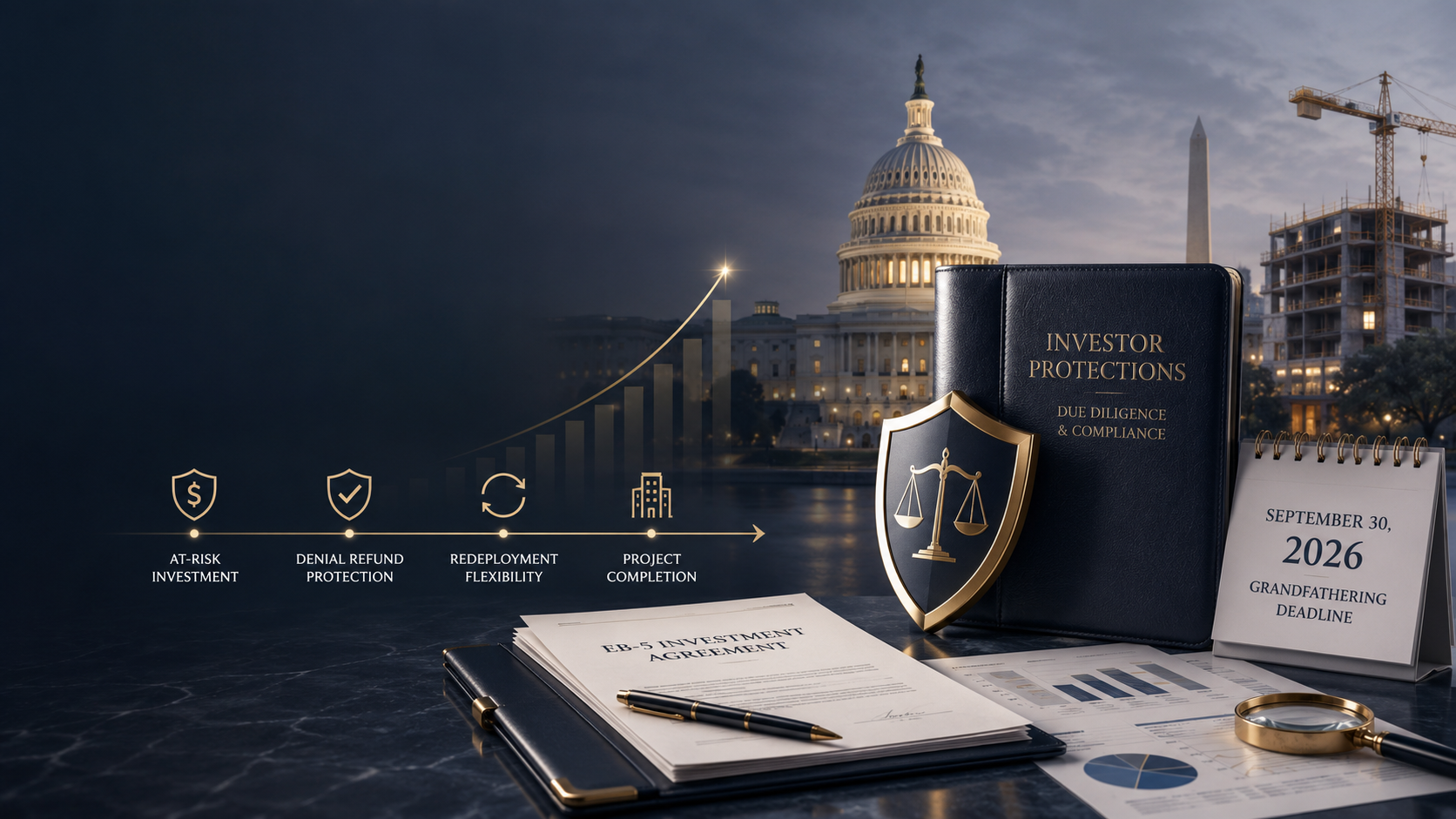
The EB-5 Reform and Integrity Act of 2022 introduced a grandfathering clause that protects investors who file before September 30, 2026. This provision addresses one of the most significant historical risks in EB-5: program uncertainty.
Under RIA grandfathering, petitions filed by the deadline lock in today's rules. USCIS must continue adjudicating your case even if the regional center program later expires, Congress fails to reauthorize after 2027, or investment thresholds increase due to inflation adjustments.
Although the regional center program is authorized through September 30, 2027, the grandfathering protection ends one year earlier. Petitions filed after September 30, 2026, are not protected and may be affected by lapses, new regulations, or threshold increases.
This distinction creates a strategic advantage for early filers. Beyond legal protection, early filing secures an earlier priority date—valuable for investors from countries with visa backlogs.
The most effective protection against project failure is rigorous evaluation before investing. EB5 Visa Investors focuses on projects with structural safeguards that align with your immigration and financial goals.
Has the developer completed similar projects on time and within budget? A proven history of delivery reduces the risk of construction delays or cost overruns that could threaten job creation.
Projects that plan to create 12–15 jobs per investor (20% to 50% above the required 10) build in a margin of safety. If some projected jobs do not materialize, you still meet the threshold for I-829 approval.
A third-party administrator tracking all cash movements adds transparency and compliance oversight. This structure is now required under the RIA for regional center projects and protects investors from misuse of funds.
Evaluate how and when capital will be returned. Projects with clear exit mechanisms—refinancing, sale, or operational cash flow—offer more predictable repayment timelines than those relying on uncertain future events.
EB-5 investments are securities under federal and state law. This gives you specific legal rights if a project fails due to fraud or misrepresentation.
If you believe you were misled about material facts—the project's financial condition, the use of funds, the developer's track record—you may have claims under the Securities Act of 1933 or the Securities Exchange Act of 1934. The SEC has brought enforcement actions against several high-profile EB-5 projects involving fraud.
If USCIS denies your I-526E or I-829, you have the right to file a motion to reopen, appeal to the Administrative Appeals Office, or refile with a different project. An I-829 denial triggers removal proceedings, but you can appear before an immigration judge for independent review of the record.
EB5 Visa Investors takes an investor-first approach to project selection and guidance. Rather than offering a mass-market portfolio, we carefully evaluate a limited number of projects that prioritize both immigration success and capital recovery potential.
This includes assessing redeployment policies, verifying construction financing, and confirming job creation projections through independent economic analysis. Our track record includes full repayment of investors in our first EB-5 project and very high approval ratings on I-526 and I-829 petitions.
EB-5 investor protections exist at multiple levels—structural safeguards in project documents, permitted USCIS protections like denial refunds and completion bonds, regulatory mechanisms like redeployment, and legal provisions like RIA grandfathering. No single protection eliminates risk, but understanding how they work together helps you make informed decisions.
Your first step is thorough due diligence on any project you consider. Your second is working with experienced advisors who can evaluate whether a project's protections match your risk tolerance and timeline. The deadline for RIA grandfathering protection—September 30, 2026—adds urgency for investors who value regulatory certainty.
Not automatically. If your project created the required jobs and your capital remained at risk during the conditional period, you may still qualify for I-829 approval. USCIS evaluates whether you met the program requirements, not whether the project was commercially successful.
At-risk means your capital faces genuine economic exposure—it could lose value. However, at-risk does not mean unprotected. EB5 Visa Investors helps you identify projects with permitted safeguards like I-526E denial refunds and construction completion bonds that comply with USCIS standards.
Under the RIA, capital generally must remain at risk for two years from the date it was deployed to the job-creating entity, assuming job creation requirements are met. In practice, most EB-5 projects hold capital for 3.5 to 5 years depending on construction timelines and I-829 processing.
When your original project completes before I-829 approval, the regional center reinvests returned capital into a new qualifying activity. You have no direct control over this decision—your operating agreement governs the terms. EB5 Visa Investors recommends reviewing redeployment policies before investing.
Petitions filed by this date are protected under RIA grandfathering. USCIS must continue processing your case even if the regional center program lapses or rules change after filing. This protection ends one year before the program's current authorization expires.
If your capital was held in escrow pending petition approval, most reputable projects return funds minus administrative fees upon denial. If capital was already deployed, recovery depends on the project's financial condition and your position in the capital stack.