.png?width=1906&height=652&name=Logo%20Pill%20Blue%20(2026_03_27%2017_45_45%20UTC).png)

Cairnspring Mills
EB-5 Due Diligence
.png?width=48&height=48&name=eb5%20visa%20investors%20favicon%20(2026_03_28%2019_48_32%20UTC).png)
When you file for an EB-5 visa through concurrent filing, one of the most pressing questions is: how long until you receive your Employment Authorization Document (EAD)? For investors already in the United States on H-1B, F-1, or other nonimmigrant visas, the EAD represents more than paperwork. It represents freedom to work for any employer while your green card application moves forward. EB5 Visa Investors helps families navigate these EAD timing questions as part of the broader EB-5 journey.
This guide covers everything you need to know about EB-5 EAD timing in 2026. You will learn how the concurrent filing process works, how long EAD processing typically takes, what the validity period means for your planning, and what steps to take if your EAD approaches expiration before your conditional green card arrives.
An Employment Authorization Document, commonly called an EAD or work permit, is a card issued by USCIS that proves you are authorized to work in the United States. For EB-5 investors who have filed for adjustment of status, the EAD allows you to work for any U.S. employer without being tied to a specific job or sponsor.
This differs significantly from employer-sponsored work visas like the H-1B, where your work authorization is linked to a particular employer. With an EAD, you gain flexibility to change jobs, start your own business, or pursue any lawful employment opportunity.
USCIS issues EADs as Form I-766, and for EB-5 adjustment applicants, the relevant eligibility category is (c)(9). According to USCIS, this category applies to applicants who have a pending Form I-485, Application to Register Permanent Residence or Adjust Status.
The EB-5 Reform and Integrity Act of 2022 introduced concurrent filing, which fundamentally changed the timeline for investors already present in the United States. Before this law, investors had to wait for their I-526 petition to be fully approved—a process taking several years—before they could apply for adjustment of status.
Today, concurrent filing allows eligible investors to submit multiple forms at the same time:
To file concurrently, you must meet several requirements. First, a visa number must be immediately available in your EB-5 category at the time you file. You can check visa availability through the Department of State's monthly Visa Bulletin.
Second, you must be physically present in the United States and maintain valid nonimmigrant status. Third, you must be admissible to the United States, meaning no bars to adjustment apply to your situation.
Currently, the EB-5 set-aside categories—rural, high-unemployment, and infrastructure projects—show "Current" status for most countries of chargeability. This means investors choosing projects in these categories can typically file concurrently.
Concurrent filing offers three major benefits. First, you can remain in the United States while your applications are processed. Upon filing Form I-485, you enter a period of authorized stay that allows you to legally remain in the country even if your underlying nonimmigrant visa expires.
Second, you can apply for work authorization (EAD) and travel authorization (Advance Parole) immediately upon filing. You do not need to wait for your I-526E to be approved first.
Third, for many investors, concurrent filing results in obtaining conditional permanent residence faster than consular processing abroad.
Processing times for the initial EAD vary depending on USCIS workload and case complexity. Based on information from immigration attorneys and recent applicant reports, most EB-5 investors receive their EAD cards approximately three to six months after filing.
Some applicants receive their EADs faster, while others may experience longer processing times during periods of high USCIS volume. The key point to understand is that the EAD is typically issued well before your I-526E petition is approved.
This means you can begin working under your EAD while USCIS continues to adjudicate your underlying EB-5 petition. For H-1B visa holders, this is particularly valuable because it removes dependence on a single employer.
While the EAD application itself (Form I-765) does not receive differentiated processing based on project type, your overall timeline is affected by the EB-5 category you select. Rural EB-5 projects receive priority processing for Form I-526E under the Reform and Integrity Act.
This prioritization means that investors in rural projects often see their I-526E petitions approved faster than those in other categories. When the I-526E is approved quickly, the entire pathway to conditional permanent residence accelerates.
In practical terms, many rural EB-5 investors receive their conditional green cards before their EAD would ever need renewal. This effectively eliminates EAD expiration as a concern for well-positioned investors.
For adjustment-of-status applicants in the (c)(9) category, USCIS typically issues EADs with a validity period of approximately 18 months to two years. The validity period begins on the date printed on the card, not on the date you filed your application.
This distinction is important for planning purposes. If it takes USCIS six months to issue your EAD, your card will still be valid for the full validity period from its issue date. In effect, you have the processing time plus the validity period before you would need to consider renewal.
Consider an investor who files their concurrent filing package in January 2026. If USCIS issues the EAD in June 2026 (five months later), and the card is valid for 18 months from issuance, the EAD would not expire until December 2027.
For rural EB-5 projects with priority processing, many investors see I-526E approval and subsequent conditional green card issuance well before this expiration date. The EAD serves as a bridge until permanent authorization arrives.
While most EB-5 investors—particularly those in rural projects—receive their conditional green cards before EAD expiration becomes an issue, it is important to understand the backup options.
If your EAD is approaching expiration and your conditional green card has not yet been issued, you can file a renewal application. USCIS allows you to submit Form I-765 for renewal up to 180 days (approximately six months) before your current EAD expires.
Yes. In October 2025, the Department of Homeland Security announced an interim final rule that ended the practice of automatically extending EADs for renewal applications filed on or after October 30, 2025. This policy change affects how you plan for potential gaps in work authorization.
Under the previous rules, applicants who timely filed EAD renewal applications could continue working for up to 540 days while the renewal was pending. For applications filed on or after October 30, 2025, this automatic extension no longer applies in most categories.
This change makes early planning more important. You should monitor your EAD expiration date and file for renewal as early as the 180-day window permits. Working with an immigration attorney helps ensure proper timing.
If your EAD expiration date is approaching and you have not yet received your conditional green card, take these steps:
Because immigration rules can change and individual cases differ, always verify current requirements with qualified legal counsel.
One of the most effective ways to minimize EAD-related uncertainty is to invest in an EB-5 project that qualifies for priority processing. Under the Reform and Integrity Act, rural EB-5 projects receive expedited adjudication of Form I-526E petitions.
Immigration attorneys have observed that rural project petitions are often approved much faster than unreserved or high-unemployment category petitions. Some rural I-526E approvals have come in as little as two months, though more common timelines range from six to ten months.
When your I-526E is approved quickly and your visa category remains current, the I-485 adjudication typically follows within a few months. This means your conditional green card can arrive well before your EAD would expire.
EB5 Visa Investors focuses on carefully selected projects that align with investors' immigration timelines. The team's expertise in concurrent filing and modern EB-5 strategies helps families understand how project selection affects the overall timeline—including EAD considerations.
By prioritizing projects with strong USCIS track records and favorable processing characteristics, EB5 Visa Investors helps reduce the likelihood that EAD expiration becomes a practical concern. You can explore current EB-5 project opportunities to learn more about available options.
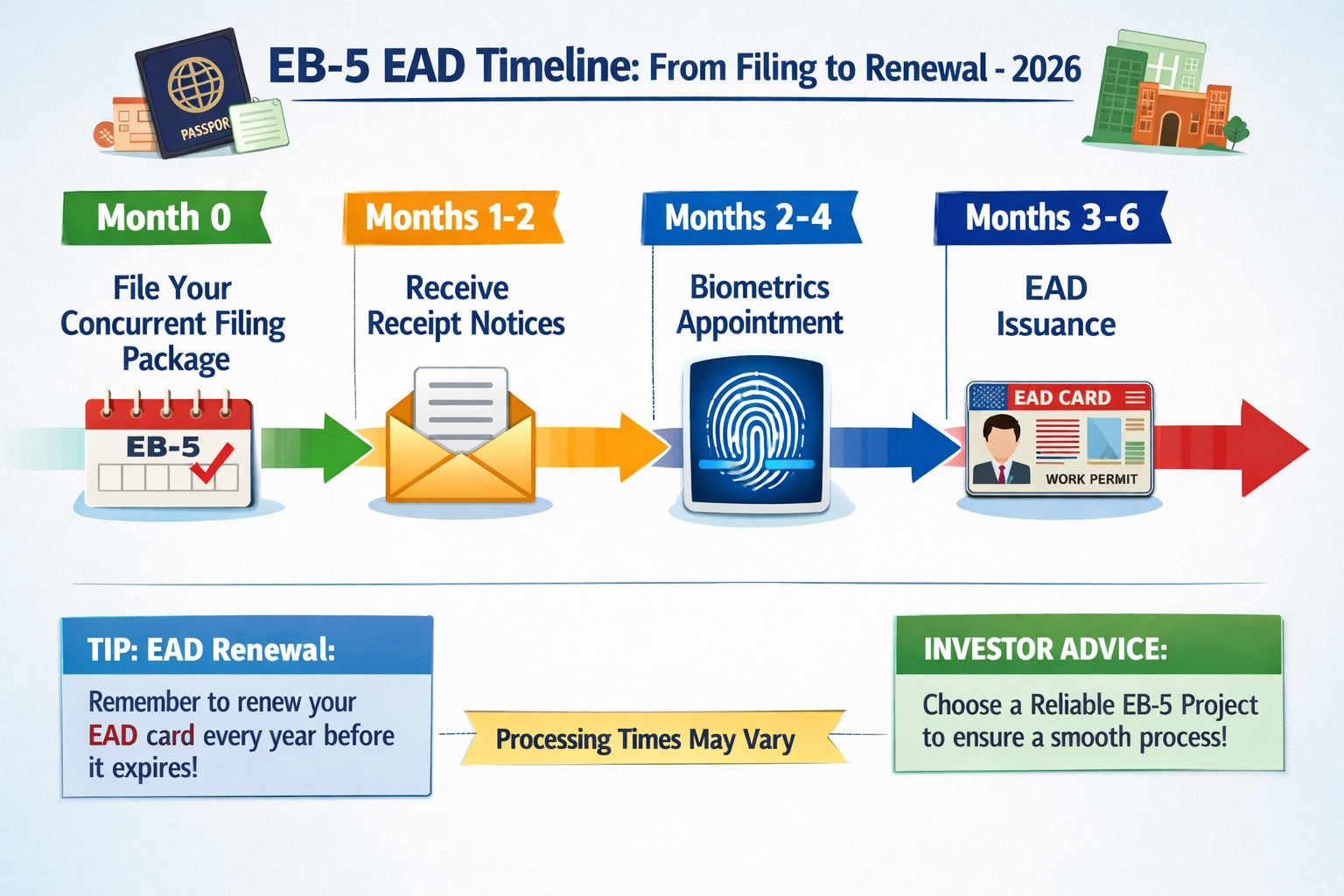
Understanding the complete timeline helps you plan effectively. Here is a month-by-month breakdown of what typically happens after concurrent filing:
You submit Forms I-526E, I-485, I-765, and I-131 together to USCIS. Each form requires its own filing fee—USCIS no longer accepts combined payments. Your priority date is established based on when USCIS receives your I-526E petition.
USCIS mails Form I-797C receipt notices confirming receipt of each application. These notices contain your receipt numbers, which you use to track case status online.
USCIS schedules a biometrics appointment at a local Application Support Center (ASC). You will provide fingerprints, photograph, and signature. This information is used for background and security checks.
In most cases, your EAD (Form I-766) is mailed to you. Some applicants receive a "combo card" that serves as both EAD and Advance Parole document. Once you have this card, you can work for any U.S. employer.
USCIS continues to adjudicate your I-526E petition. For rural projects with priority processing, approval may come as early as month 2-6. For other categories, processing times are longer and more variable.
Once your I-526E is approved and a visa number remains available, USCIS adjudicates your I-485. Upon approval, you receive conditional permanent resident status and a green card valid for two years. At this point, your EAD is no longer necessary for work authorization.
If your green card has not yet arrived and your EAD is approaching expiration, file Form I-765 for renewal. Do this as early as possible within the 180-day window to minimize any gap risk.
Yes. The EAD allows you to work while both your I-526E and I-485 are pending. Your work authorization is based on the pending I-485 application, not the I-526E petition. This is one of the primary benefits of concurrent filing.
If your I-526E petition is denied, USCIS will typically deny the associated I-485 application as well. This would terminate your work authorization under the (c)(9) category. You should consult with an immigration attorney immediately if you receive a denial to understand your options, which may include appeal or motion to reopen.
Yes. Eligible derivative family members—your spouse and unmarried children under age 21—who are included on a pending I-485 may each file their own Form I-765 applications. Each family member receives a separate EAD card.
USCIS does allow expedite requests under certain circumstances, such as severe financial loss or humanitarian reasons. However, expedite requests are granted at USCIS discretion and are not common for EB-5 EAD applications without compelling circumstances. Standard processing for EADs is generally reasonable at three to six months.
The most effective approach to EAD timing is proactive planning before you file. Consider these factors when structuring your EB-5 investment:
Rural EB-5 projects receive statutory priority processing under the Reform and Integrity Act. This means USCIS is required to adjudicate rural I-526E petitions before other categories. Choosing a rural project can significantly accelerate your path to the conditional green card, often making EAD renewal unnecessary.
Visa availability can fluctuate throughout the fiscal year. Filing while your category shows "Current" status ensures you can take advantage of concurrent filing. Monitor the monthly Visa Bulletin published by the Department of State to understand availability trends.
Your attorney can monitor processing times, track policy changes, and advise on timing decisions. Immigration rules can change—as seen with the October 2025 automatic extension rule change—and professional guidance helps you adapt your strategy accordingly.
Note your EAD expiration date and set a reminder for 180 days before. This gives you the full window to file for renewal if needed. Even if you expect your green card to arrive before expiration, having a backup plan reduces stress.
The EB-5 EAD timeline in 2026 follows a predictable pattern for most investors: file concurrently, receive your EAD in three to six months, and work freely while your I-526E and I-485 are processed. For investors in rural projects with priority processing, the conditional green card often arrives well before EAD renewal becomes a consideration.
The key to success is understanding how these timelines interact and planning accordingly. By selecting a project category with favorable processing, filing while visa numbers are available, and maintaining awareness of your EAD expiration date, you can move through the process with confidence.
EB5 Visa Investors simplifies this complex process by focusing on projects that align with modern EB-5 strategies, including concurrent filing benefits and priority processing advantages. For families navigating the path from nonimmigrant status to permanent residence, understanding the EAD timeline is one important piece of the larger immigration puzzle.
Most EB-5 investors receive their Employment Authorization Document approximately three to six months after USCIS receives their concurrent filing package. Processing times vary based on USCIS workload and case complexity.
EB5 Visa Investors helps families understand these timelines as part of the overall EB-5 process guidance, ensuring realistic expectations from the start.
Yes. The EAD issued to EB-5 adjustment applicants under category (c)(9) allows unrestricted employment authorization. You can work for any U.S. employer, change jobs freely, or start your own business without needing employer sponsorship.
This flexibility is one reason concurrent filing has become popular among H-1B visa holders exploring EB-5.
If your EAD approaches expiration and your conditional green card has not yet been issued, you should file Form I-765 for renewal. USCIS allows renewal applications up to 180 days before expiration. EB5 Visa Investors recommends working with your immigration attorney to ensure timely filing and compliance with current rules.
Yes. Rural EB-5 projects receive priority processing for Form I-526E under the Reform and Integrity Act. This faster adjudication means many rural investors receive their conditional green cards before their initial EAD would expire. EB5 Visa Investors focuses on projects in categories that offer these processing advantages.
Yes. Your spouse and unmarried children under age 21 who are included as derivatives on your pending I-485 can each file their own Form I-765 applications. Each qualifying family member receives a separate EAD card with the same validity period and employment flexibility.
EB-5 investors with a pending Form I-485 use eligibility category (c)(9) on Form I-765. This category applies to adjustment of status applicants and authorizes employment based on the pending green card application, not the underlying I-526E petition status.